[This is from back in January- I hadn’t made my plans to go to graduate school known back then and, well, living in a small town, word gets out one way or another, so I was being cautious. Now that people know that is the rapidly approaching plan, it’s probably ok to publish this post.]
Tomorrow, I am going back to school.
Sort of. I’m taking one class- it’s on how to do proper historical research.
When I was in college, I was in the unusual situation of only being in school- I didn’t have a job, school was my job. I really enjoyed being in school, even having to run from the top of one hill to the top of another in 10 minutes to make my classes. Well, maybe not that. The rest of it was pretty enjoyable though.
It’s hard to believe that I got out of college in 2017, almost five whole years ago at this point. I told myself I would go work for a few years, maybe one or two then go back to school when I knew what I wanted to get my masters in. The timeline stretched out a bit- I had flexibility in my job and my interests changed multiple times- and then of course the global pandemic. It’s now pretty apparent that I have the length of time in a museum to qualify for jobs elsewhere, but not the degree so now is the time.
One catch though- my background isn’t in history. The graduate advisor I’ve been speaking with gave me two courses I should plan on taking so I could get into the Masters program, one class being this history method and theory class and one being the senior seminar (sometimes called capstone) class for history undergraduates. Luckily, I know the teachers teaching the courses so it’s not a huge undertaking to get all signed up for them. It is a bit funny, showing up at a history cohort in their last semesters and being like “I am in this class now, hello classmates”.
While making dinner tonight, it crossed my mind a bit frivolously- what am I going to wear on the first day? It’s tradition for me to have a good first day outfit mostly for myself to honor the excitement of a new semester. This pandemic has really cramped my style though. I used to wear dresses on the daily, and now my go-to is jeans and a t-shirt. Part of that is because I finally got tired of being cold and not wanting to change clothes between warmer clothes to walk Parker and work clothes, then back to warm clothes for the evening walk.
I could go bold with my Museums are Not Neutral t shirt, or go professional with a nice blazer and stick out like a sore thumb in laid back Arcata, or just jeans and a t-shirt to blend in with everyone else. Backpack or no? Maybe I’ll break out some of the earrings I’ve been buying on Instagram. Shoes- likely running shoes since I’ll have to park far away to avoid having to pay for parking and schlep myself all the way up to the second floor of a building on the top of the main hill on campus. The last time I made the hike up there, likely 2019 at this point I realized I really needed to do more walking. Maybe tomorrow will be a little better with all the hiking I’ve been doing with Parker.
One of the textbooks for the class arrived at my house a few days ago and I eagerly sat down to read some of it- the other three should show up tomorrow. It feels a bit like Christmas Eve. I figure this time around, attending a class while also working full time, is going to be rather different than when I was a full time student, but it’ll be a good trial run for me to see how I can make it work, as I’ll likely have to do that when I get into the actual Masters program.
Today is the 137th anniversary of the Chinese Expulsion from Eureka, CA so I have been working on a small gathering to acknowledge the day at the site of Eureka’s Chinatown as part of the Eureka Chinatown Project. Here are my short remarks for the event.
On this site in 1885, there was a community, 200-300 people, many from Guangdong province in China. They were shop keepers, fishermen, farmers, cooks, laundry workers, construction workers, and servants- also sons, fathers, brothers, uncles, and daughters, mothers, sisters, and aunts. Following a terrible accident, they were forcibly removed from this place and became part of a lineage of forced removal not only here but across this country once xenophobic acts were legalized and then broadly supported by national, regional and local leadership.
The destruction of this community is what brings us together today, in memory but also in solidarity and in hope. There is a growing community through the Eureka Chinatown Project striving to reimagine this place- City, County, and Nation- as a place where our neighbors, friends, shopkeepers and family of Asian descent can be safe, connected, and recognized for their important contributions to this place we all call home. We are updating the past narrative of Eureka’s Chinatown to one that recognizes the events that took place here, but also the the overwhelming strength it took for Chinese immigrants to get here and live in this environment that is difficult not only for one’s physical existence but for cultural existence at a time when xenophobia reared its head and changed this place and hundreds of lives forever.
Thank you for joining us to acknowledge this day, the strength of the people who lived here, and the work that is being done.
Today, I found out my partner’s roommate tested positive for COVID. They had been sick for a few days, and once they started showing symptoms a little less than a week ago, my partner and I stayed apart and I started working at home waiting to see what the diagnosis was. Early rapid results tests all came back negative, but the more official (and accurate) PCR test they took on Thursday came back today as positive.
The effects its had on me, this waiting for the official test results and not knowing what was going on had a strong effect on me- paired with some less than good news from work, Parker knocking me over to chase a cat, and my bathtub leaking into the laundry room below made for a rough start to the weekend, and leaves me wishing for 3 day weekends rather than 2 day weekends, along with wishing that COVID test results didn’t take 2-4 days in our rural section of California.
Today, Parker and I went to Stinky Beach. I found two soda cans that were likely from the 1970s or 1980s judging by the openings- they were pull tabs, with the tabs pulled, the cans emptied and crushed. I picked them up, along with some styrofoam, a rubber belt, some white plastic strip of some kind, and a very distraught looking bicycle pump that I had to wrench out of the sand, drag the mile or so back to the closest trashcan off the beach.
That was all surprisingly tiring, so I came home, brewed some tea, and took a nap. The tea is still there, now cold and probably oversteeped.
I feel a bit like that sometimes when I get onto the internet these days- checking the news or Instagram on my phone, Facebook on the random chance that I am on an actual computer since I deleted the app to lessen the platforms I could doomscroll on. At least Google News eventually has an end to its scroll, but I still feel terrible once I get to the end of it. I feel like I know too much, not good stuff but dark and bitter things. Not even dark and bitter in the way that dark chocolate is, dark and bitter in the way that 3 hour steeped black tea is- two sips and you want to throw it out the window.
I keep mulling over just deleting my accounts on social media platforms for good, but the millennial and historian in me doesn’t want to miss out and doesn’t want to loose this little snapshot of early 2000’s life: sharing memes and photos of me and my friends and family growing up, the collective WTF of young liberal types in response to 2016-2020 and the reign of the Cheeto. So here I am, trying to moderate my access instead. It works sometimes.
Then other times, I am scrolling and see things that ignite something in me- someone getting engaged or buying a house, and a voice in me says “that should be you.” Someone got a new job? “Should be you.” Reconnected with an old friend? “What are you doing ya doofus? That should be you doing all that!”
The “Should-er” lives rent free in my mind, and now that I’m aware of it, it’s annoying as heck. It comes out to give an opinion even when the thing I am seeing that I “should” be doing is something that I don’t really have an interest in doing- going out for drinks or a concert for instance. Drinks, maybe, but not at a time like this and concerts? Too loud. But I should be there.
Social media in particular brings this out so much- FOMO is what most people call it these days. I experience another dimension of it where I feel like I am not only missing out, but falling behind on some imaginary curve of where I “should” be in my life. That curve is also incredibly ambiguous- married at 25? Yeah, likely not for me, that’s pretty young. I can’t remember to brush my teeth sometimes, being married is a whole other ballpark of responsibilities. But 30? Isn’t that kind of old? Aren’t the good dudes taken by then? I don’t know. Throw the experiences of the last 5 ish years into the mix and I think anyone who is telling you there is some kind of established expected progression is having a pipe dream. We are all making it up as we go along. Past expectations live on though, with annoying consistency that grow in strength as things become less secure and established. If only this oversteeped tea could be watered down a bit.
(sorry for the missing accents on some of the words, I’m not sure how to get them into the text)
My first love in life was bread. Or books. It’s a pretty close tie.
But I remember heading home from the store with my dad, a hot loaf of french bread, or somedays even sourdough, in my lap, trying to only eat half of it before getting home about 5 minutes later. I’m talking a feeds a full family during a spaghetti dinner loaf of bread here. I’d eat as much of it as possible on the way home, and the rest at home followed by a big glass of milk (and later, as stomach ache). Of course, most of the bread I ate as a kiddo was your typical plain, maybe even savory French bread or tangy sourdough.
Ahead of the Museum’s Festival de Migraciones this past weekend, an article came up about a local panaderia (bakery) selling pan de muerto or, “dead bread”, a traditional sweet bread baked around dia de los muertos or the day of the dead, a popular holiday held in Central America, especially Oaxaca. Nice, tan circular loaves with little bone shapes on them and usually sesame seeds or sprinkles. The flavor reminds me a lot of a lightly sweet cinnamon roll minus the oppressive amounts of frosting. I ordered a bunch of them, along with conchas, or sweet bread with frosting, for the museum and they sold very well. It helped that they were absolutely gorgeous as well, and ridiculously fresh. When I went to pick them up, they had only been out of the oven for about 20 or 30 minutes and their sweet smell filled the covered bed of my pickup truck, billowing out when I went to unload them at the event. If I hadn’t been totally overrun with adrenaline, I would have probably tried to eat at least a few of them.
Since our sweet success at the festival, I had been thinking of how I could get some cash, which I rarely carried and get some more sweet bread from the little El Pueblo panaderia. On my way home from work today, I found a few bucks in my purse and a plethora of change in my wallet (where did it come from?? Divine providence probably). I stopped in at the small market and stared at the five glowing cases of sweetbreads, none of which I knew the name of. There was a person in line in front of me, chatting with the clerk picking out breads, the clerk offering something else and the woman declining, paying her $6.85 and leaving. The transaction was all in Spanish. Some of the people in the market spoke English, and my Spanish is, well, minimal- I am a good fly on the wall but can’t say too much unless I really sit and think about it- but we made it work. I recognized the clerk from the weekend before, when I picked up 75 sweetbreads for the festival, I’m not sure if he remembered me. I contemplated my choices, limited by three dollars and a bunch of random change. I picked out a yellow rolled pastry “Lemon?” the clerk asked.
heck yeah I said in my head “yes please”
I paid my $2.50 and headed out, excited to break into it in the truck before headed home.
It was a yellow sponge-like cake with jelly on the top along with some kind of flaky sugar, and jelly in the spiral of the cake. It reminded me of a yule log in how the jelly was rolled into the cake, which was probably baked flat then rolled, topped with sugar, and cut. I’m usually not a fan of jelly, but there was enough to be interesting without overwhelming. Of the two types of Mexican pastries I had tried, they seemed to both do an outstanding job of walking that line carefully- sweet, but not too much so. It was something a coworker of mine had commented on earlier in the week when I, once again for probably the fourth time in the week leading up to the festival, mentioned the pan de muerto. It was an exciting new foodie discovery for me and I couldn’t stop talking about it.
I thought about the other pan dulce (sweet bread) I had seen- bright pink and white cut like biscotti, pink cookies, one that I swore looked like candy corn, round rolls, with sesame seeds or unadorned, muffins, cones filled with some kind of frosting. The last few times I had been in here buying pan de muerto for myself, friends, coworkers or the museum ( I had been in there a lot recently), I saw some new shape or color of bread.
While the bread cases were my personal highlight of the shop, there were also boxes of papayas and sweet potatoes, bags of chicharrones(fried pork skins-freshly made from the look of it), corn husks for tamales, a variety of hot sauces and what looked like roasted peanuts, cheeses, cremas, Mexican candy, and more, packed into a storefront probably not larger than a 20×20 foot space. The building itself is much larger, you can just barely see behind the counter how far back it goes for the bakery itself. Hand written signs for tamales by the dozen (noted), CASH ONLY and flyers for English language classes and for now past dia de los muertos events were taped up near the door to the bakery. When you opened the door, a long doorbell chime would ring, I swear it went on for at least 10 or 15 seconds- ding, ding, ding dooong, ding ding ding doonngggg- the same tune the Catholic school I went to would play to mark the hour each hour.
In the parking lot is an outstanding taco truck- their carne asada super burrito is different but outstanding, probably second only to my pre-pandemic memories of Los Giles (pronounced HEE – lays, not Giles like Buffy) located out in Arcata.
I imagined myself one day comfortably ordering in Spanish, and not totally embarrassing myself or the store clerk. “como se llama eso?” pointing at a bread I didn’t know the name of- today I saw some that were in the shape of pigs, which I thought were cute. I was embarrassed today to ask what they were, I didn’t want to seem out of place or inexperienced, but I knew deep down I already was and the clerk probably knew that when I walked in the door.
A quick google search labels the pig cookies as marranitos or puerquitos (little pigs or piglets). They’re also referred to as Mexican gingerbread cookies. Hell yeah, I love gingerbread. Guess I know what I’m getting next time I can scrounge up some random money.
“Todos el marranitos, por favor- todos! Toma mi dinero!”
Rain is finally coming down here on the north coast, and it looks like it’ll be coming down for the next week or so. Parker is having a bit of a hard time figuring out how to feel about that- He gets all excited to go for a walk when I get home, but then when I try to get him to go in the yard to pee he runs away because it’s raining. Same, bud. Same.
I find myself at this time of year wearing softer clothes to be cozy and comfortable at work more frequently, and listening to the “Pumpkin Spice” Spotify channel at work. The very first day that it began raining this year, I ran to my room, threw a few more blankets on my bed and burrowed in.
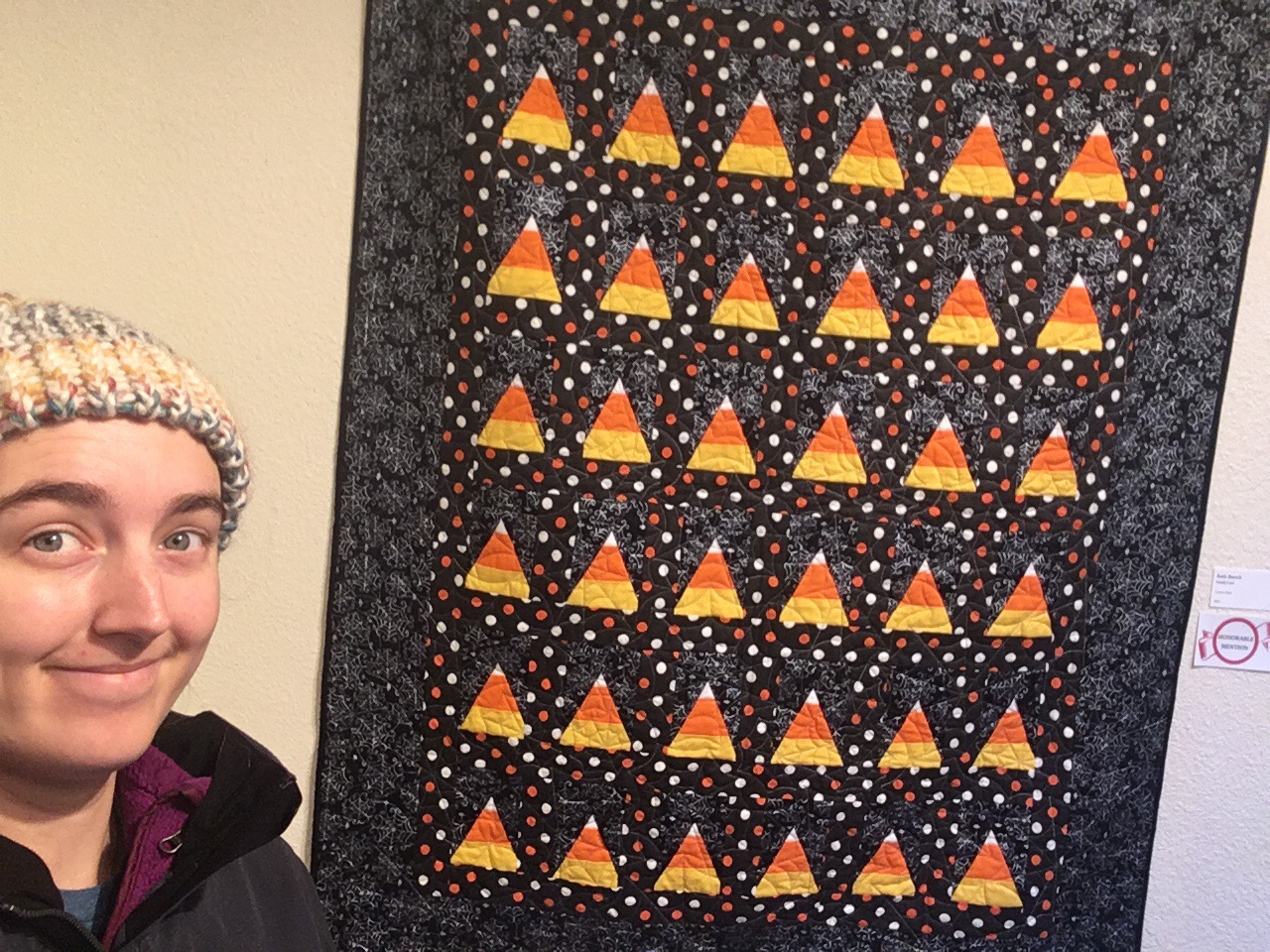
What’s fall without candy corn? (My quilt in the Redwood Art Association Halloween exhibit got an honorable mention!)
My books are looking more inviting these days, I whipped through The Great Pretender by Susannah Cahalan and have been working on Humboldt Homegrown: The Golden Age by Edward Parsons, which is the fictionalized story about a guy who grew weed in Humboldt County in the 1970s. It’s a solid 600 pages and was written in 1985, but I figure if someday I’m going to do an exhibit on weed in Humboldt County, I should read the materials that are out there talking about the history- and there are only a few books out there about it. I also started (and finished)reading “The Sum of Us: What Racism Costs Everyone and How We Can Prosper Together” By Heather McGhee which was good in explaining how we get the phenomenon of white people in poverty shooting down policies that would help them and many others (expanded public healthcare, better schools, etc) because those policies would also help a smaller but still present population of people of color. I’ll write more about this in a later post.)
Still on the bookshelves are, well, a lot of books. Warmth of Other Suns, The Human Swarm, many of the things Clifford Geertz wrote, Nothing Like it in the World, which I know was written by a known plagiarizer, but I got it for free so I feel less bad about it. Two Faces of Exclusion, The Protestant Ethic and the Spirit of Capitalism, Arabian Nights, The Sum of Us, God and War, Dispossessing the Wilderness, on and on and on. I’ve been doing well on not growing the collection of books to read, and have been doing well at chipping away at what I have. Lately though, I’ve been itching to get ahold of some Vine Deloria books- I read “Playing Indian” by Philip Deloria, Vine Deloria’s son, a while back and more recently finished the podcasts This Land and All My Relations which have piqued my interest in contemporary Native issues. Matika in All My Relations references Deloria’s God is Red in one episode, and when I went to look it up, I remembered hearing mentions on Custer Died for Your Sins being read in HSU’s Native American Studies classes. As I learned more about Deloria’s writing, I grew more excited.
(I admit that while writing this, I went onto eBay and finally hit the purchase button on the Deloria books and a few others I have been adding to my cart over the last few months… Time to clear out some of the shelves to make some room it looks like. I’ve since started God is Red and so far, it’s been pretty interesting. From what I’ve read so far, its a deeper dive into Native religion beginning in the 1960s American Indian Movement (AIM) and how Native traditions have interacted with contemporary forces like the Civil Rights Movement. I’ll probably write more on this later. Other books in that order include “Indians in Unexpected Places” by Philip Deloria, “The Power of Myth” by Joseph Campbell- a throwback to my Religious Studies days, “Indians and Anthropologists” by Vine Deloria Jr, “For This Land: Writings on Religion in America” By Vine Deloria Jr, “Evolution, Creationism, and Other Modern Myths: A Critical Inquiry” by Vine Deloria Jr, “Decolonizing Methodologies: Research and Indigenous Peoples” by Linda Tuhiwai Smith, and “The Little Book of Restorative Justice” by Howard Zehr.)
This time of year, I think of Katie Wilson.
When I was in school, I took a class called Consumerism and EcoSpirituality. The title makes it sound a lot like Hippie 101, and it being led by a wiccan who wrote her masters thesis on Burning Man didn’t help, but it’s a class I’ve come back to multiple times mentally since graduating. It took place in a partially underground classroom, with a sliver of a window that looked out on what I vaguely remember might have been a magnolia tree. The teacher, also named Katie, one time was talking about how our mental states turn inward as we head into fall and expand outward as we go into spring, as the winter is a more internal, contemplative time and spring is a more outgoing and growth oriented time. I think about that a lot to give myself a break for those days when I really just want to sit around and read while it’s cold and rainy out. Throughout the semester, she’d comment on the magnolia tree, noting when it began to grow new leaves and bloom. Part of that class included setting aside time each week to sit down and write outside about what the world looked like. I remember really enjoying that assignment, and the class in general. We spend so much time in school being in our own heads, it was a good reminder to check in on what is going on outside too.
The class was discussion and participation based, with some writing assignments here and there because something needed to go in the grade book. I admit, I don’t remember much of what happened, but that’s the same for other classes I took where there were a lot of assignments.
I wish I knew what happened to Katie Wilson- HSU gutted the Religious Studies department after I graduated and I have no idea where she went. She also taught a class called Death and (Im)mortality that was outstanding- it was in the evenings in the fall, getting out at 8 or 9 at night, long after the sun had set so I walked home in the dark, mind whirring with thoughts. It wasn’t hard to stay awake in that class- it was fascinating. It was there that I learned about the sci-fi-esque afterlife of the Mormons. I also remember seeing a particularly thought-provoking video about the Tibetan Book of the Dead that had my head spinning for at least a few hours after seeing it in class. (Turns out, the very serious narrator is Leonard Cohen, and the movie was made in 1994)
Out of 8 planted pumpkin plants, two survived to put out major vines and one produced this lil pumpkin.
We have two flags on the front of our house that are absolutely whipping around in the high winds right now- I have a feeling they might be shredded in the morning. Parker is curled up by my feet asleep despite not getting a second walk this evening. He did get a dental chew though, and he was as excited about that with perhaps a similar amount of excitement as he expresses when he gets a pig ear.
Or, why I choose to call this place “Mormon Disneyland”
(I’m not alone in feeling like some of the Mormon educational spots are a bit Disney-esque, sounds like they’ve been like that for a while)
Back in June, when the Pandemic sucked a little less, I went out of town with my partner, who was making a trek for a board game tournament. I kind of forced my way into the trip, not going to lie, but not because of the tournament but because of its location.
Salt Lake City. Mormon Town, USA.
I went to school for Religious Studies (and Anthropology) and since I focused a lot on American religious traditions, the Mormons of course came up. Since then, I’ve listened to podcasts, read books, and did some armchair not-so-serious research on Mormons and the LDS Church. I had always hoped to get out to Salt Lake City- I’d only flown into it once on my way to go skiing in Big Sky- and this was my chance.
“you know I’ll be busy the whole weekend with my tournament, right?” My partner asked. “We might not get to hang out much or anything”
“Oh, that’s fine, there’s tons of stuff for me to see in Salt Lake- museums and churches and statues and-“
“Sounds fun” he said flatly.
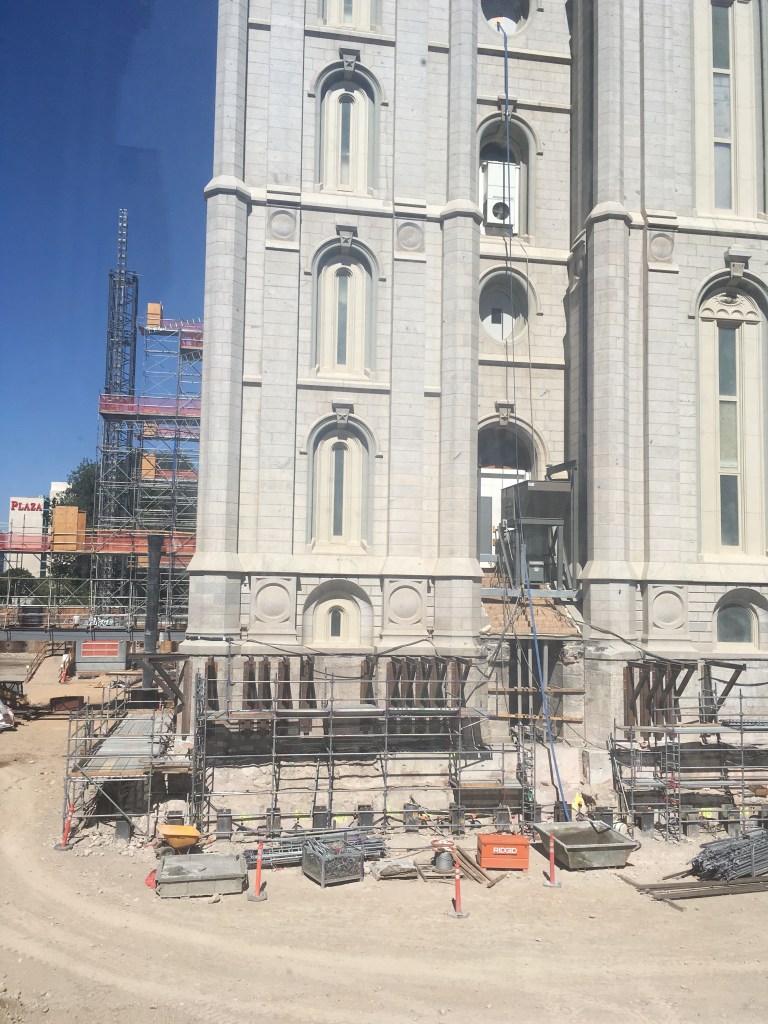
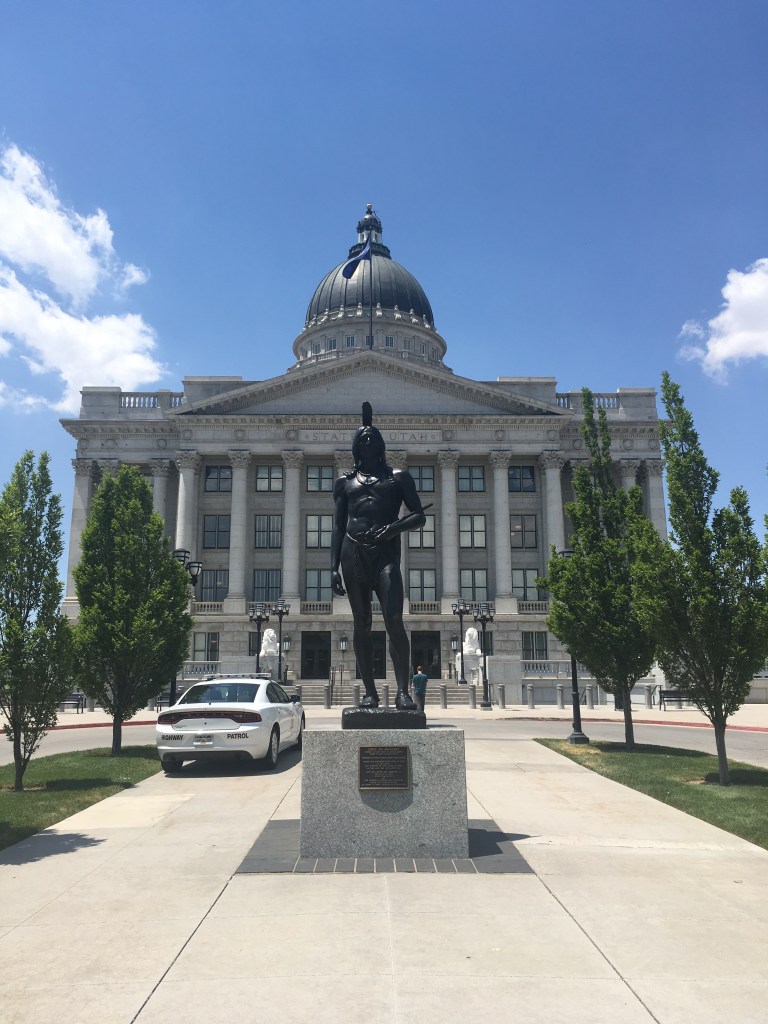
My first day in town consisted of me walking about 10 miles in 80-90 degree heat up to the Capitol building, around Temple Square, out to the train station and through some of the stores in town. Most of the Museums were closed because of COVID (a huge letdown), but I did learn that the Temple, which was being earthquake retrofitted, would be open to the public for six months after the renovations were complete in a few years. The Temple is never open to the public- only the Mormon-iest Mormons can go in there typically, but I’m guessing since there have been so many Gentiles in there during the restoration work they figure 6 more months probably won’t hurt- might even get some converts. You bet that I will be back for that.
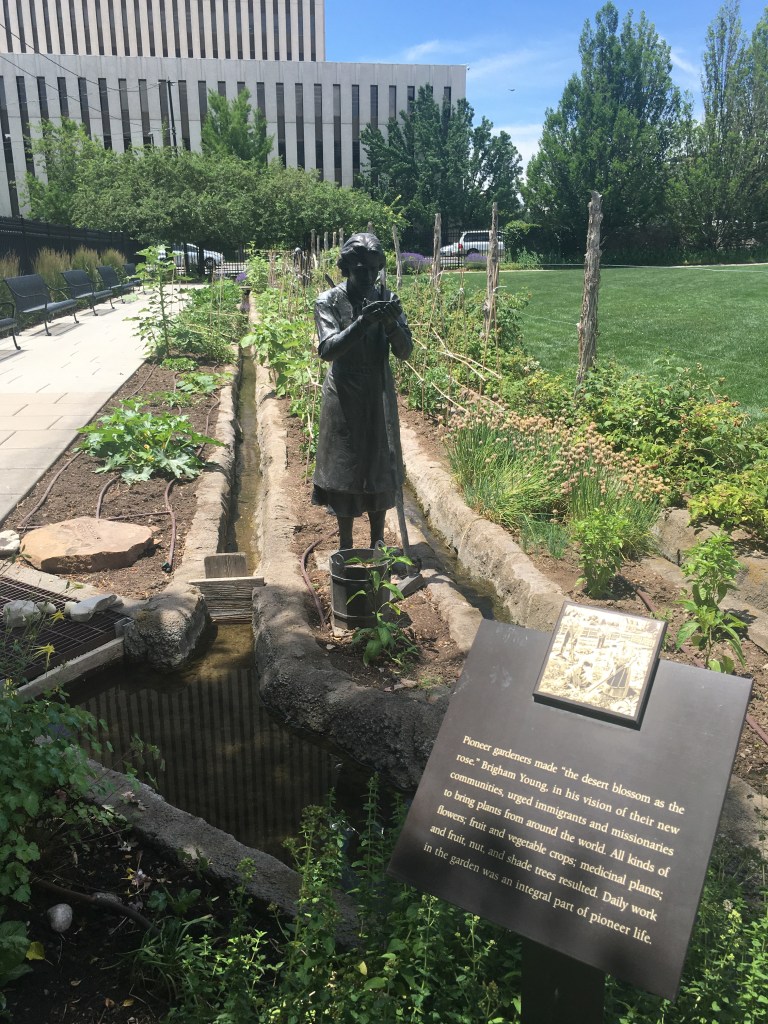
One thing I did notice, especially around Temple Square, was that every single planter was full of plants, almost overflowing really, but well maintained. I know in the Mormon stories about the establishment of Salt Lake that there was a huge emphasis on agriculture and just planting anything to see what would do well- that focus on plants and abundance obviously continues today (and is probably heartily funded by the Church of course).
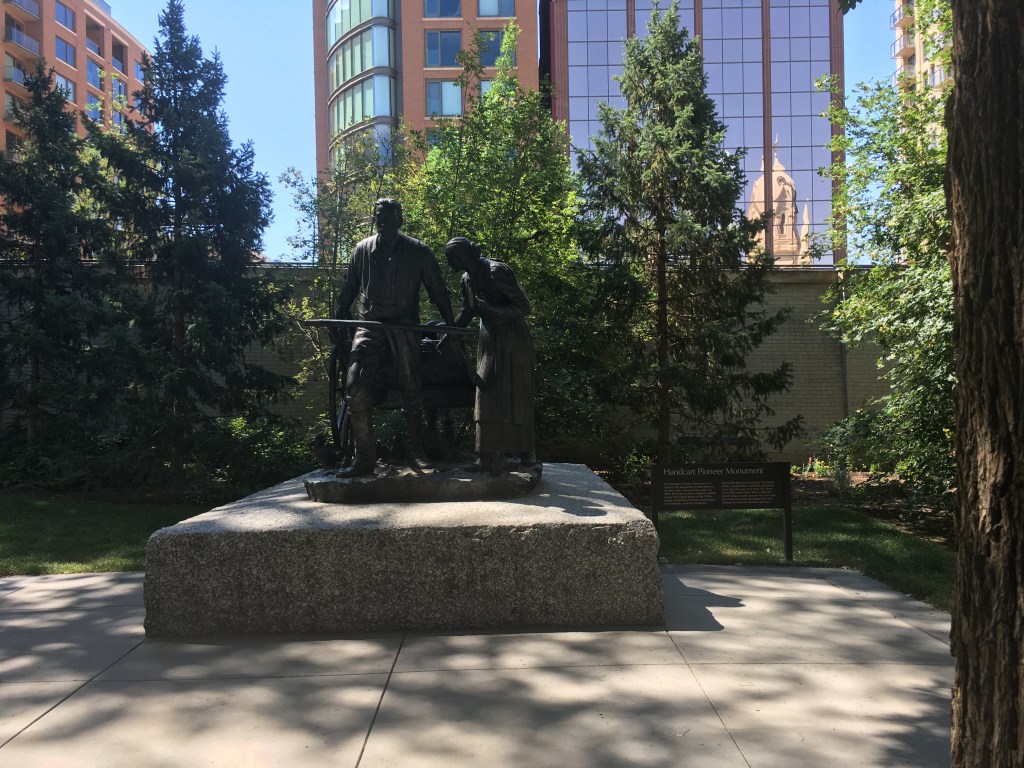
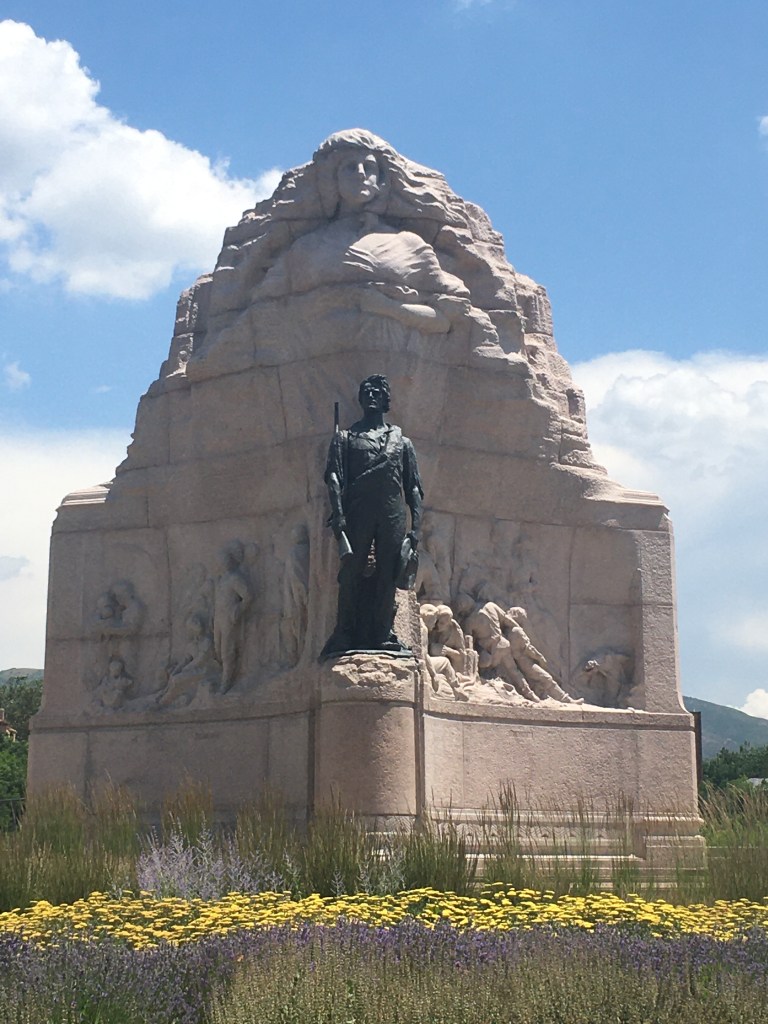
I did get some fun photos of some of the monuments, parks, and other things around Salt Lake- I’ll have to come back to these later and riff on them:
I don’t know what I expected, but I do know that what I saw wasn’t quite it. I haven’t been able to figure out who exactly owns the park or operates it, but based on the number of missionaries who worked there, and it’s location super close to Salt Lake, many fingers point towards it probably being a LDS operation. It wouldn’t be surprising considering how many buildings related to Brigham Young are on site and it’s heavy focus on, well Mormons. Mormons do love their history.
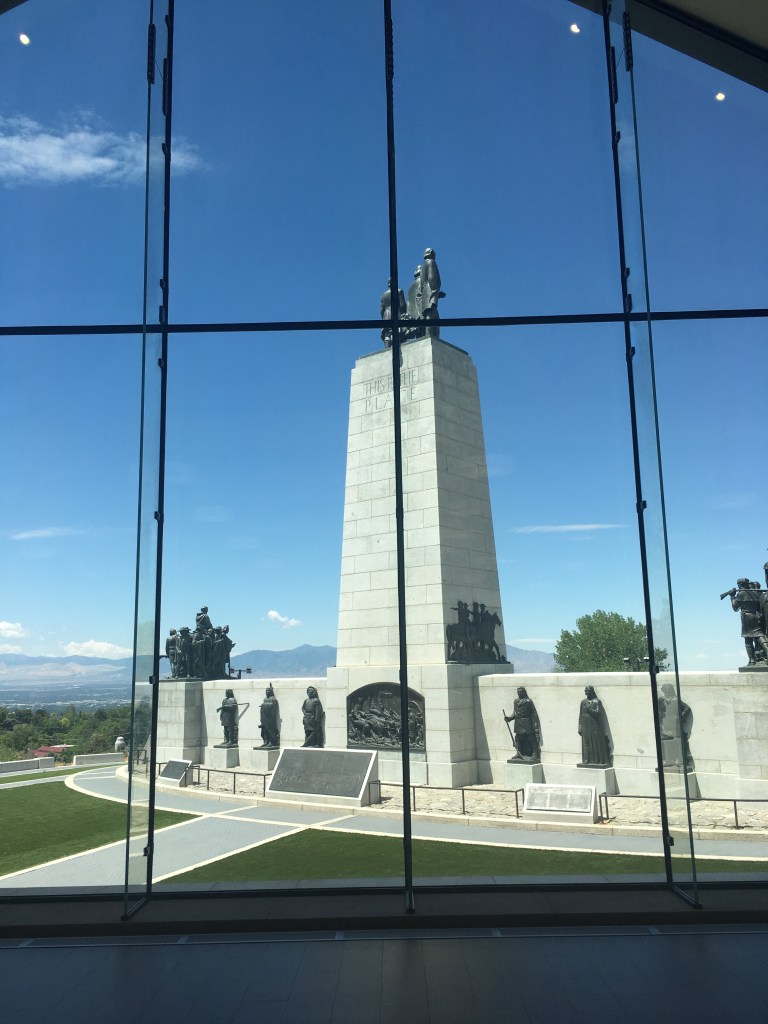
That’s one big tower- as seen through the Pioneer Center (Visitor Center) windows
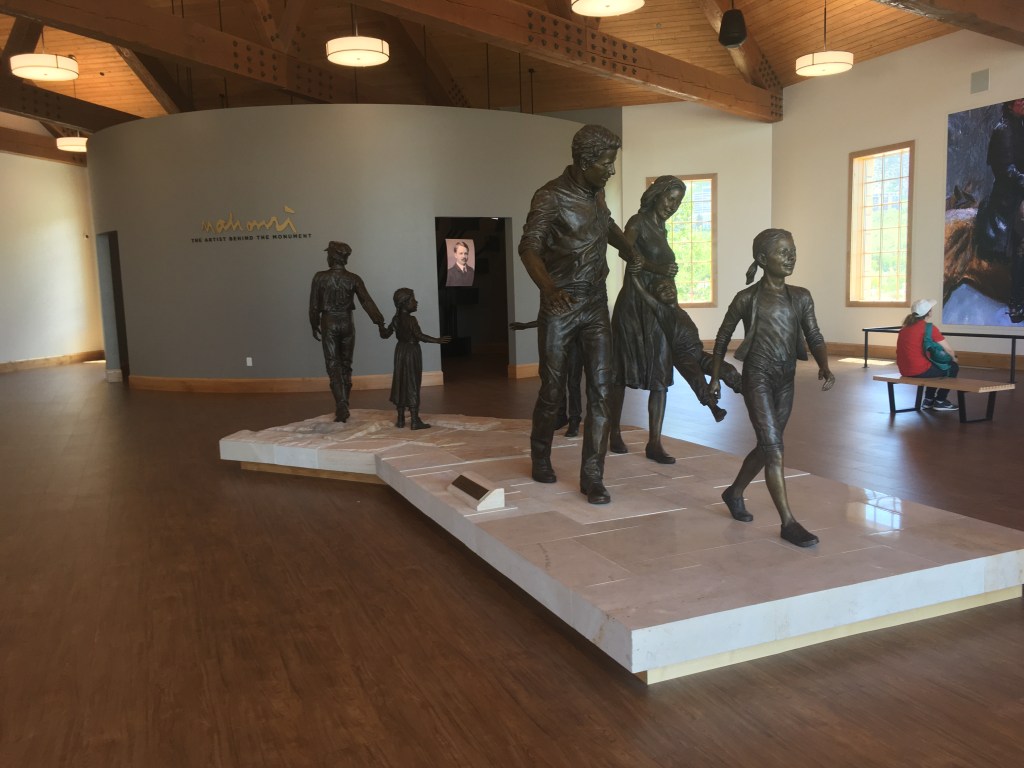
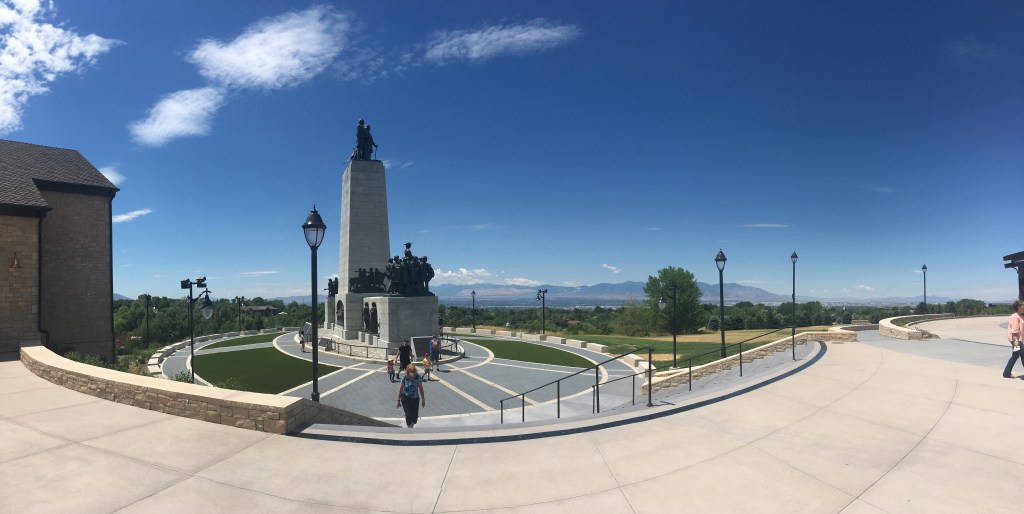
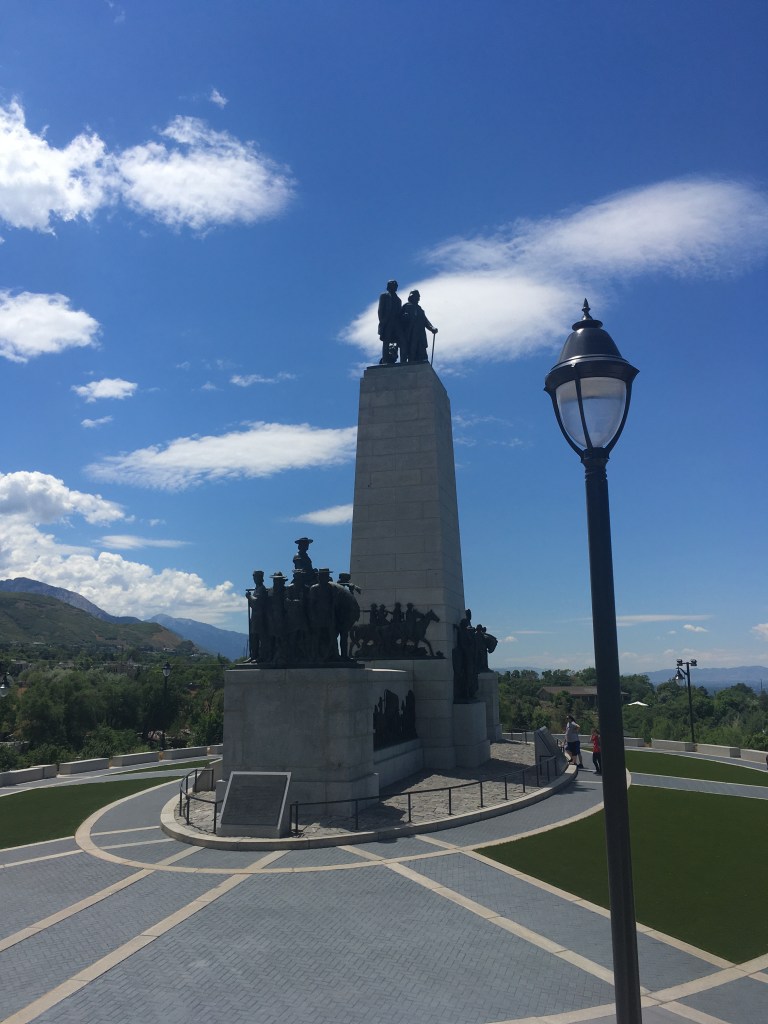
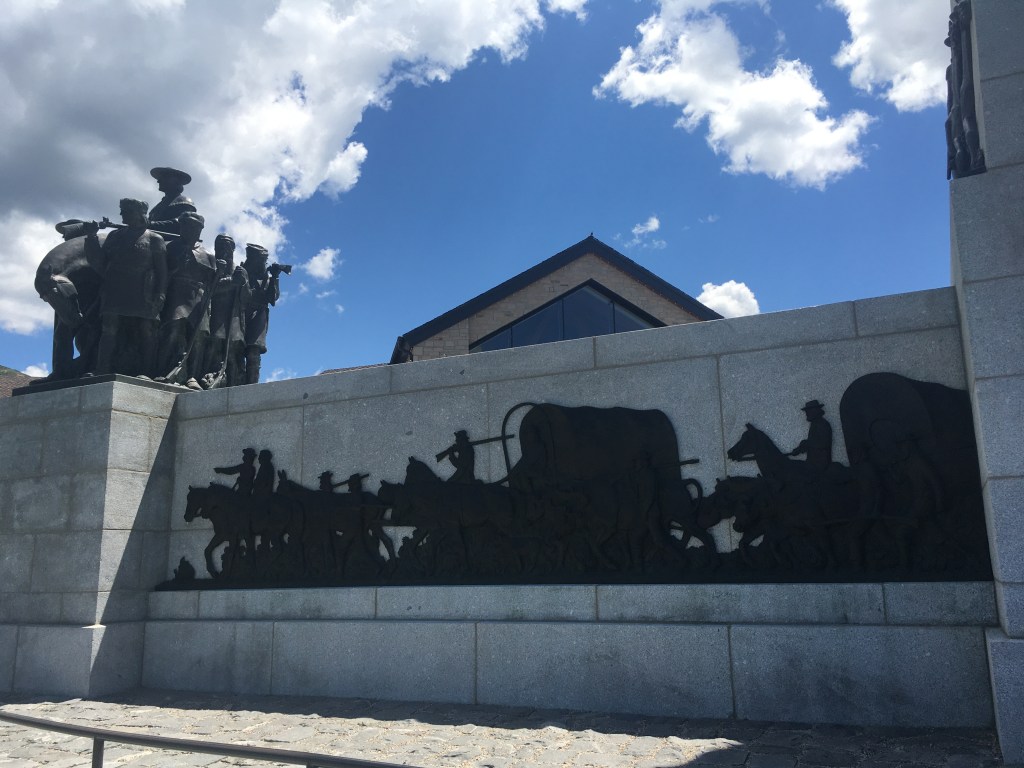
First of all, I parked and went into the Pioneer Center, which was huge and spacious- a new addition to the Park it seemed, with a few exhibit space talking about the building of the “This is the Place” Monument- a big honkin’ tower with the likeness of Brigham Young, Herber C. Kimball, and Wilford Woodruff on the top and a whole crew of others in both statue and relief around the base. The Monument can be viewed (along with its outstanding backdrop looking over the Salt Lake Valley) through a huge floor to ceiling window in the Pioneer Center. Near that window is a collection of statues that display and evoke the feeling of moving from the past into the present and future, with two young pioneer children reaching their hands out to a modern day child and her family moving toward the monument. This was my first interaction with the really interesting and numerous statuary at the park.
Dang, I thought I got a better picture of this.. There are two pioneer kids near the back, one is an older boy leading a younger girl by the hand while she reaches out to a modern younger girl who is reaching out as well. What is assumed to be the modern young girl’s family is striding ahead confidently towards the big windows at the Center, which was behind me while I took this picture. Guess I’ll have to go back to Salt Lake and retake the picture someday.
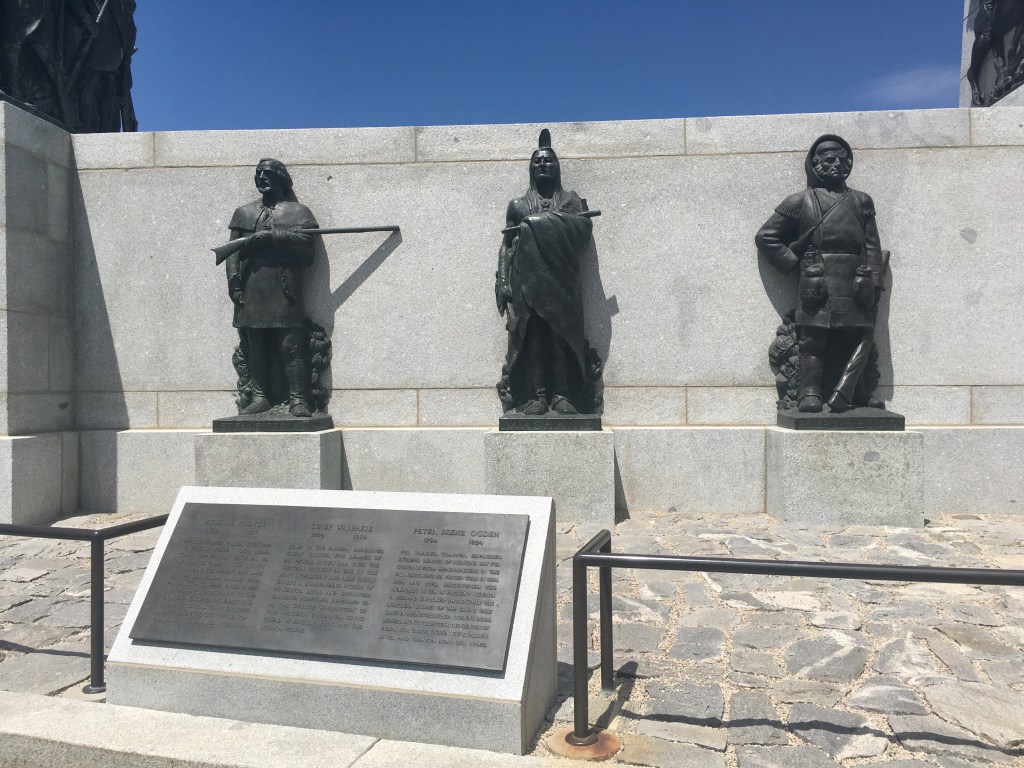
There’s also this humungous multi-panel video screen off to the far right of the image above that tells the story of the Mormon pioneers through various paintings and whatnot, it’s all very inspiring, although very quiet on the Native history of the area. I think the only references to Native history in the park are one of the statues at the base of the This is the Place Monument and the Native shelters, which I’ll take about later.
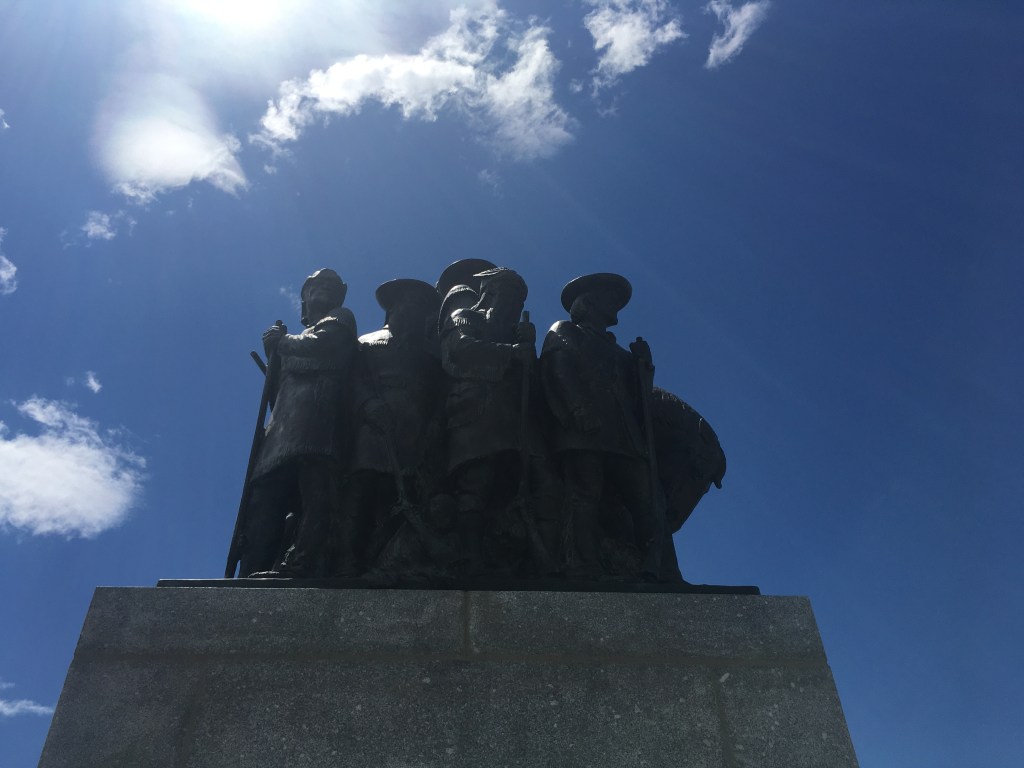
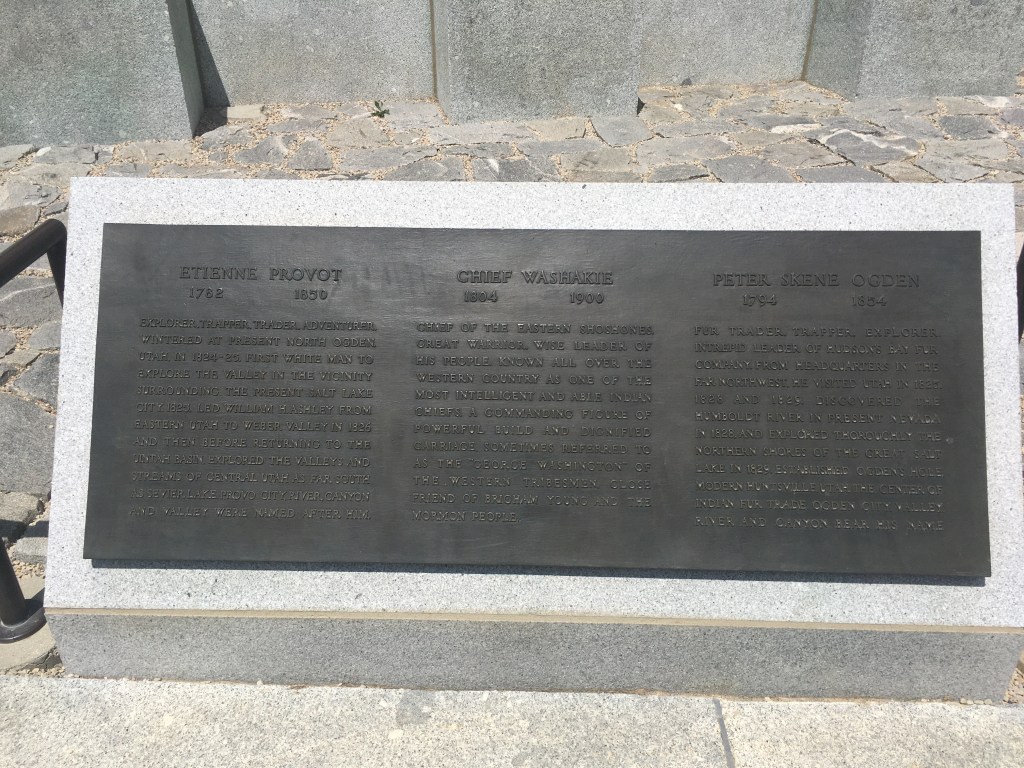
I headed out to the big monument and, being a nerd, read all the plaques which told a version of the Mormon migration tale and explained who the various people were on the monument who played roles in the migration story. Hunters, trappers, and Indians on the back side of the monument, pioneers on the front. Movement from the past (on the back side of the monument) to the more recent present (closer to the front of the monument) and the location of statues in relation to one another plays a big role here and adds significant depth to the statues, monuments, and location as a whole.
While I could probably write a whole book on just this monument, I should keep rolling along here.
To get into the park itself, you walk through a replica of the “Eagle Gate”. The Eagle Gate was a fancy archway Brigham had over the gate to get onto his compound in what is now downtown Salt Lake. It has *surprise surprise* an eagle on it, which is flying over a beehive, the emblem for Utah nowadays that stems from Brigham’s association of the beehive and a strong, cooperative, and industrial work ethic. The one in downtown Salt Lake is a massive version of the 22 foot wide original one, as the present day one spans over four lanes of traffic. The original Eagle Gate does still exist still- it’s in the Daughters of the Utah Pioneers Museum in Salt Lake (which was closed when I visited).
If you’re not paying attention, you might get hit by a train- ok, that’s a bit of an exaggeration. Upon entering, you’re on a road, and every 15-20 minutes or so, a motorized train (woefully described as a “historic replica” on the website) pulling a few passenger cars pulls up to a nearby stop- you can hop on and get a ride to other areas of the sprawling park. I took a street-by-street approach and began wandering.
One of the pioneer cabins moved to the park, now overlooking the Salt Lake Valley.
The compound is laid out on a grid with houses, community buildings, stores, a bank, a jail, and any number of other buildings. Most were the original buildings themselves, picked up and moved to the site for preservation. Some were recreations of the originals which had been torn down or lost in fires. Many of the buildings had (Mormon Missionary) living history actors in them, some performing artistic tasks like leatherworking or blacksmithing, with others providing information or selling things like… donuts? The website for the donut shop says they use a special ingredient used by the pioneers? (fact check, the donut was invented in 1847, Salt Lake was also settled in 1847, I’ll give them that one)
The community hall at the Park that now sells Brigham’s Donuts
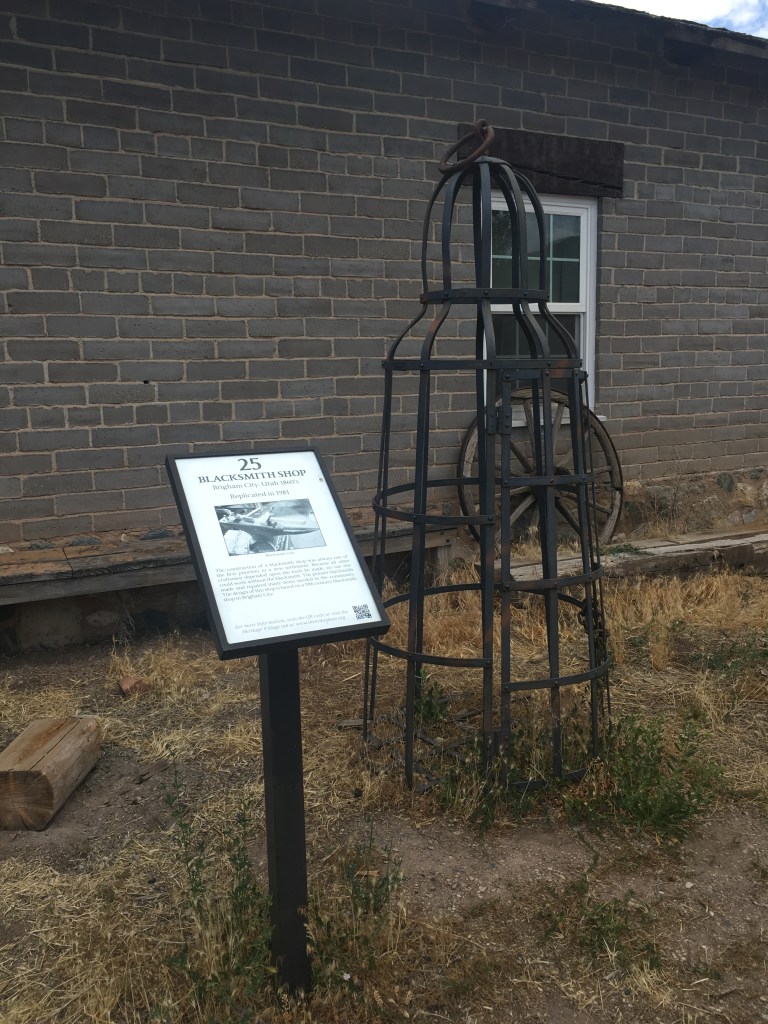
Hey blacksmith, what’s with the torture devices?
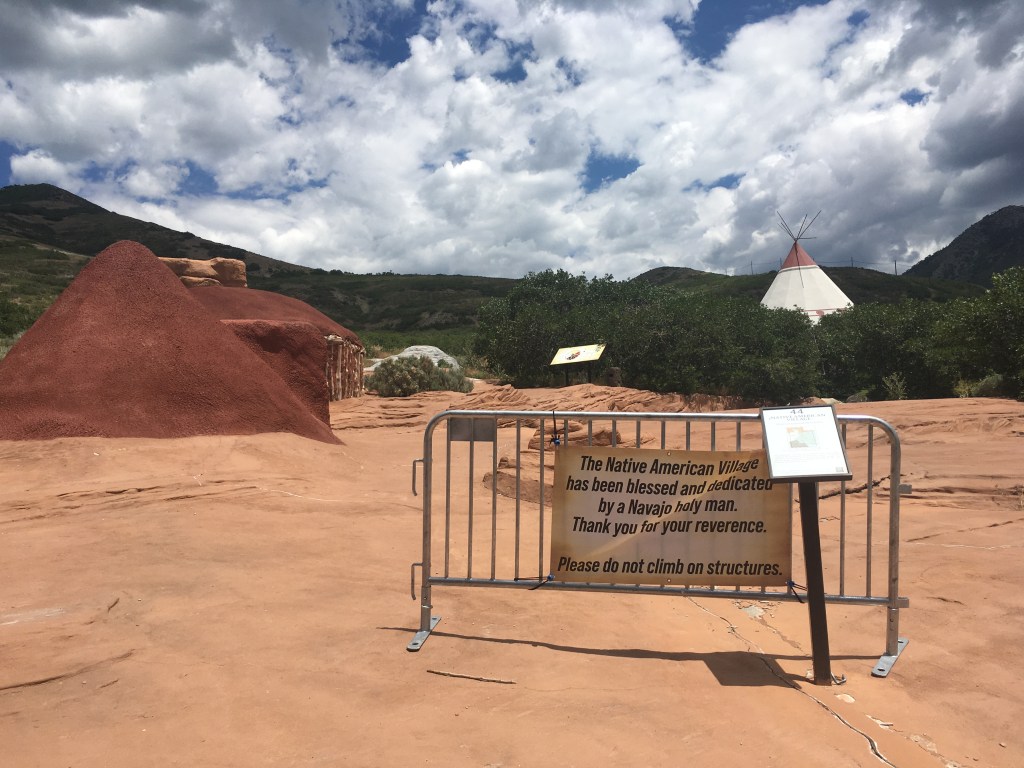
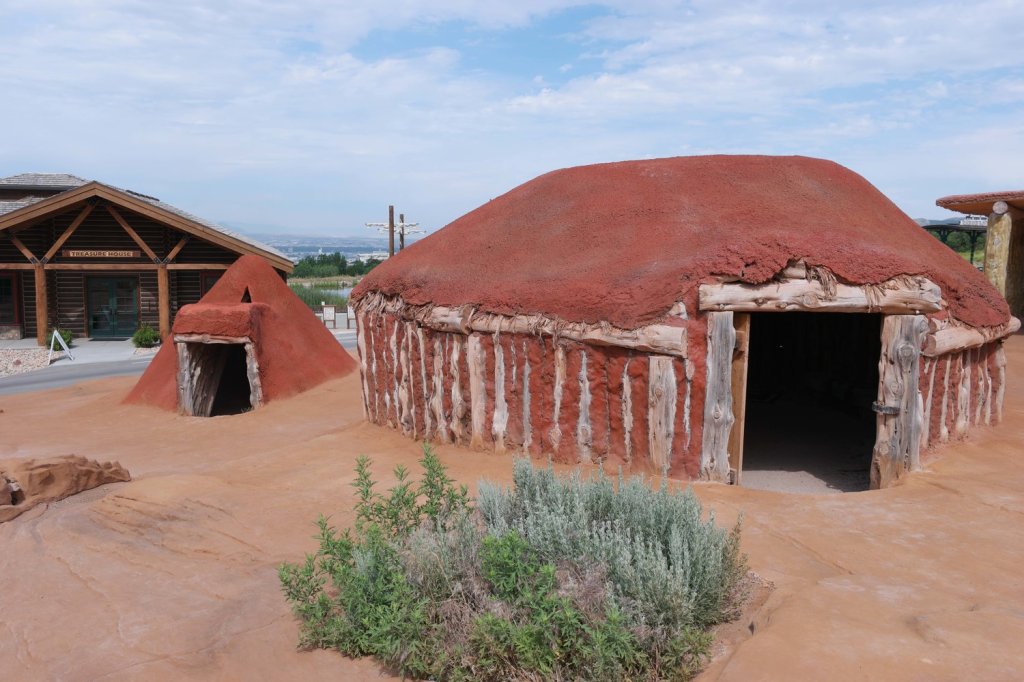
Eventually, I trekked up the hill to one of the newer parts of the Park, which hosts a representational Native American Village, which includes representational dwellings for the Ute, Navajo, Paiute, Goshute and Shoshone people. On my way in, I saw this sign:
“A Navajo Holy Man” – Alright?
The only open building was the tipi, where a woman was showing how corn is ground up and allowing people to try sitting on a woven sitting mat. It was a little odd to say the least. Signs and interpretation was super limited in the area, and it was deserted. The website has more information on what the experience is usually like, as COVID probably had some big impacts on how things were operating. I did find this mention on the website entertaining:
This new Teepee, the largest in America, can easily seat 110 guests in the comfort of air-conditioning in the hot weather and has heat for visits during the cooler months.
There was also a big medicine wheel painted on the ground in one area near the tipi and Hogans.
Recreated hogans
recreated (concrete) tipi (from This is the Place Heritage Park Website)
This site was located overlooking an extremely popular simulated gold panning activity area happening just down the hill where people would go to a log-cabin style building, pick up their bag of dirt, and sift it in an artificial creek below the building. That’s worth thinking about. The juxtapositions in this place are just crazy when you really crack into them.
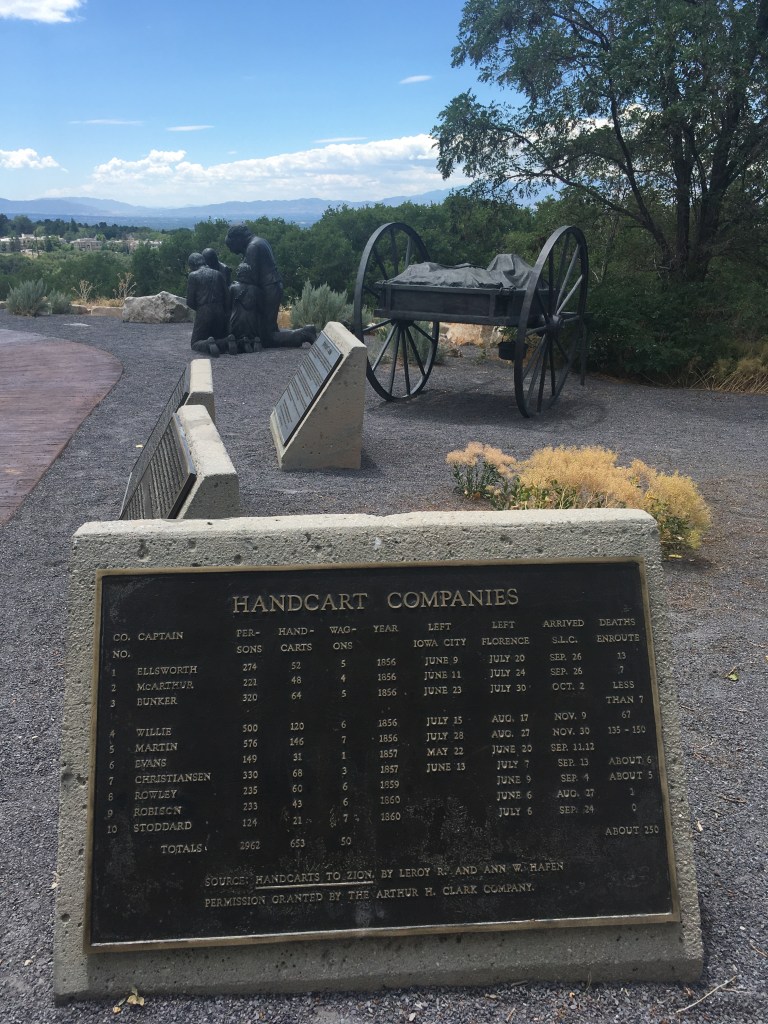
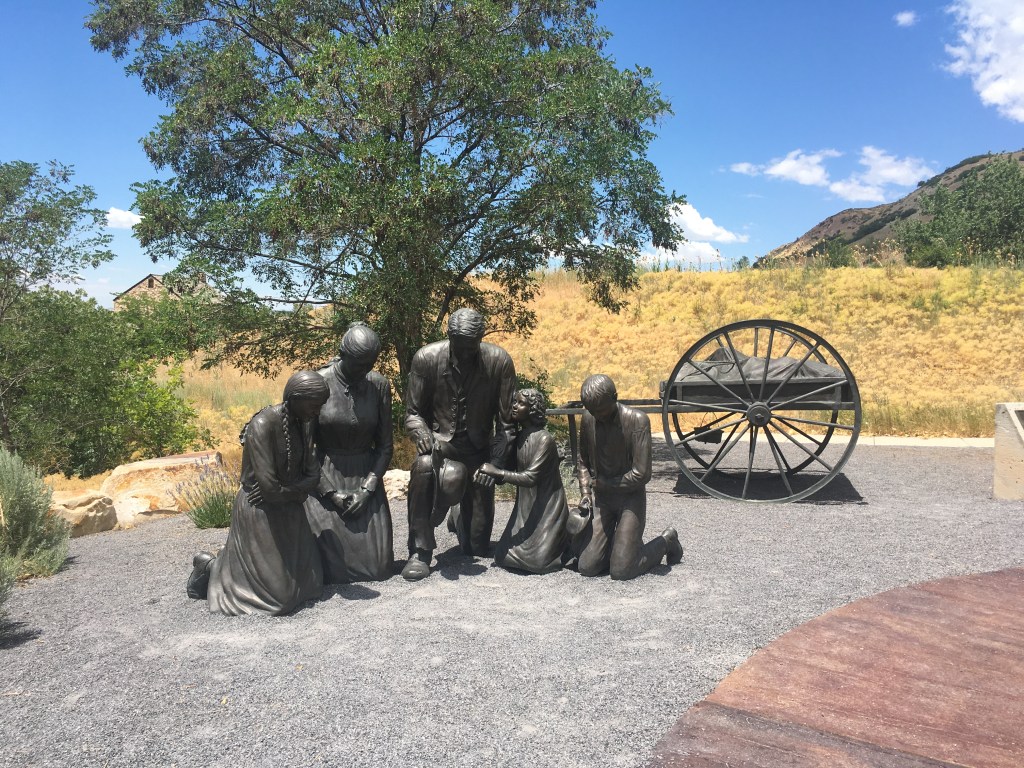
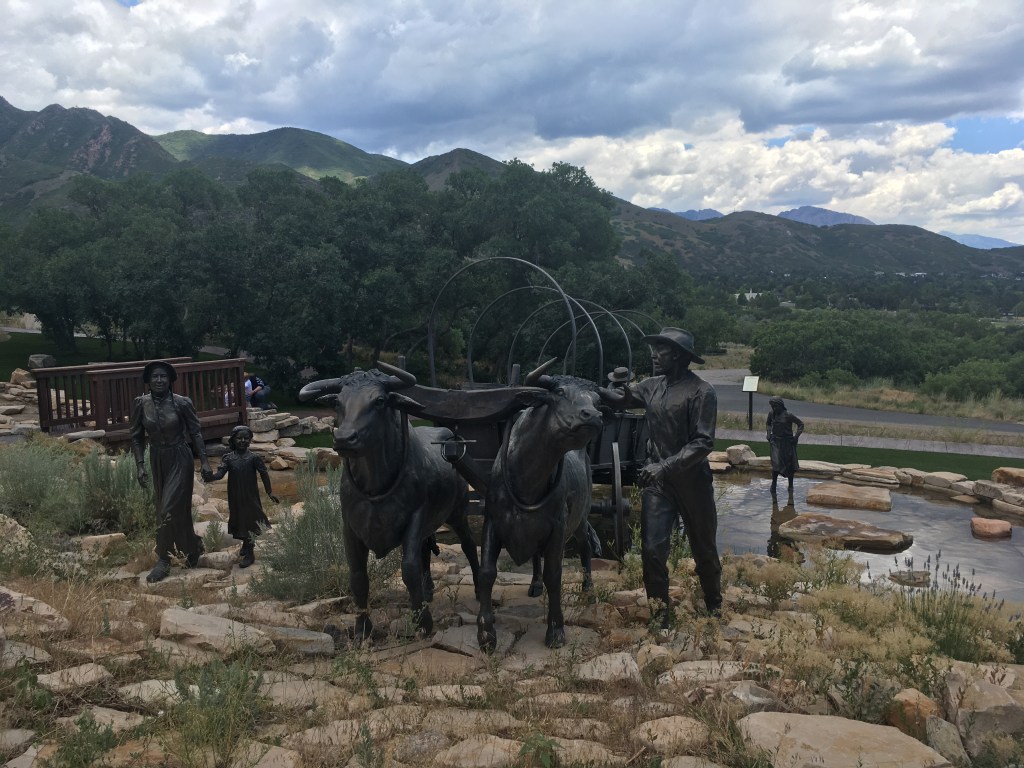
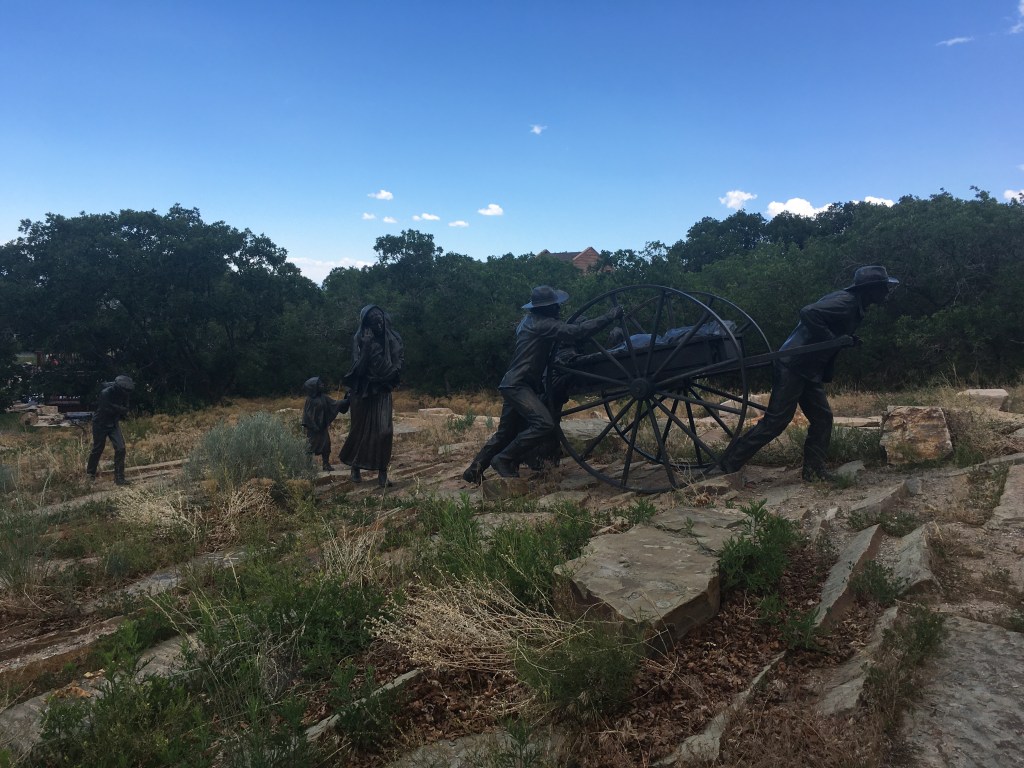
Near that gold panning frenzy was a path that led to a big patch of artificial grass with a few larger than life statues of two parents and three children praying. When I first walked up, a whole gaggle of adults and teens were climbing all over the reverent statues, laughing and shouting, getting a group picture then hopping off and walking away. The statue, which also included a larger than life handcart nearby, was called “Journey’s End” and was associated with a few plaques talking about the trials of a later group of Saints that, after spending most of their money sailing to the United States from Southern and Eastern Europe, couldn’t afford to get oxen and covered wagons so they had to push and pull large two wheeled carts (handcarts) across the United States all the way to Utah. Handcart companies traveled to Salt Lake from 1856 to 1860 and over the course of the travels, according to LDS plaques at the site, about 250 people died, many due to surprise snow storms or other mishaps, while about 2,900 people did make it. The handcart journeys got a bad rap from all the people dying en route- one party that is highlighted later on in the trail for instance, the Martin party, lost 250 people out of 900 according to some accounts, largely due to winter conditions encountered on the trail when the party left in August when they should have left in May or June to beat the winter weather, greatly miscalculated travel times, and inadequate supply stops along the route.
More about these carts in a little bit.
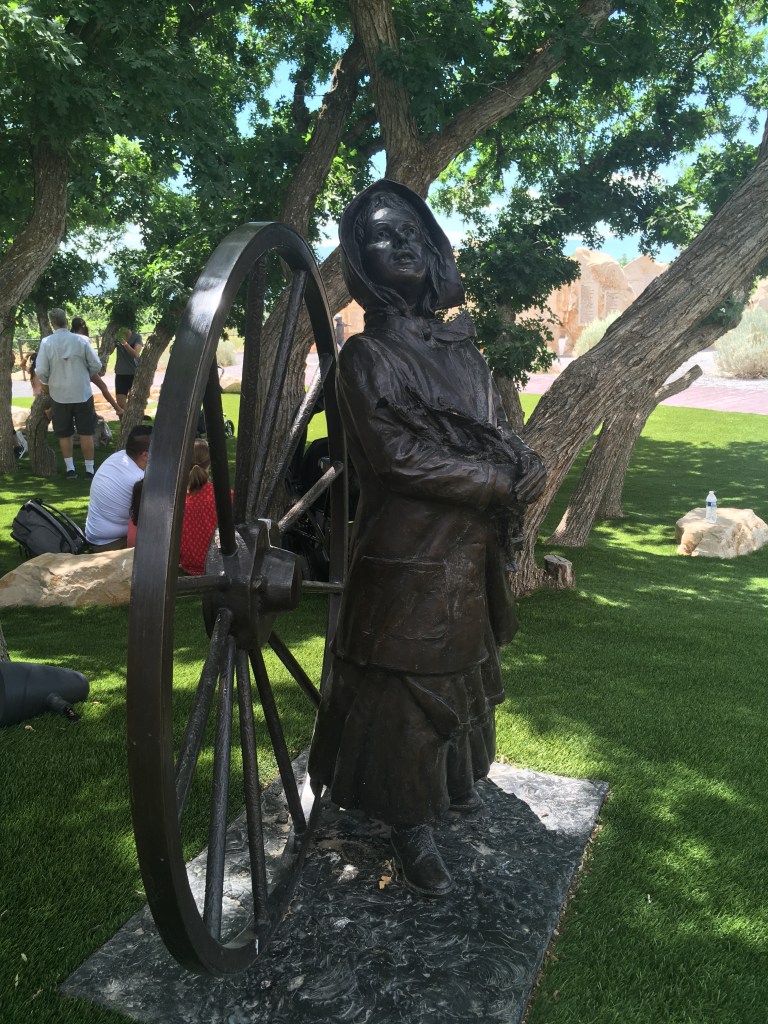
Situated maybe 20-30 feet away from the praying family was a statue of a young girl, maybe 12 or 13, sitting on the ground. She was more normal size in comparison to the huge family of giants nearby, and had a small sign with a push button on it. A narration emanated from a hidden speaker disguised as a rock. You can listen to it here. I may have been a bit dehydrated or something, but it took me a bit to realize that this was the end of a whole trail of these bronze statues- the path continued down the hill, paralleling and sometimes crossing over an artificial creek flowing over bright orange sandstone. The intent was that you climbed the hill, experiencing a tiny taste of the trek up and over mountains, across prairies and rivers to get to the Salt Lake area- instead I experienced a leisurely stroll downhill, leaving some energy for contemplation. Kids were climbing around in the stream the whole way down the hill as I stopped at each statue and pushed the accompanying button to hear the stories. The very last one (which was the first stop if I had been going the right way) was a statue of a small girl, maybe 6 or 7. She stood next to a bronze wagon wheel. Her story was of her sitting next to the wagon one night, falling asleep, and never waking up because she died from exposure. Damn.
Other stories included pioneer handcart companies being hit by a snow storm when they had run out of food and being rescued by help sent from Salt Lake, dragging pushcarts over mountains with names like “Rocky Ridge”, and crossing hazardous rivers with wagons and oxen.
The juxtaposition of the nice creek, laughing children and absolutely grim and difficult tales was a bit jarring to say the least. It was effective though as both a solemn memorial and a place of respite for children to enjoy in the summer heat. The layout of the statues, trail, and creek flowed well. It made me really think about the individual stories of people who came out to Salt Lake, and I’m sure for the Mormon folk out there it highlights the struggle that their ancestors wrestled with and the grace of God to find religious freedom and a new home in Zion (the Salt Lake City, Utah area). The viewer can experience a (much more leisurely than the pioneers, but still uphill) taste of the pioneer experience by walking up the hill and viewing the Great Salt Lake at the top of the hill, perhaps declaring between labored breaths ‘this is the place!’
The final (or beginning) of the trail had a series of 16 huge sandstone monoliths with the engraved year, name, and age of each child who died on the way to Salt Lake, about 600 of them identified so far through the LDS’ extensive family research work. The boulders are accompanied by statues of children, or modern day parents with children, which is a bit spooky, but probably comforting for people who might otherwise be really shook by facing hundreds of names of dead children.
I made my way back into the town area and looked for some shade and to see if I might have missed anything. That’s when I saw the handcart shop.
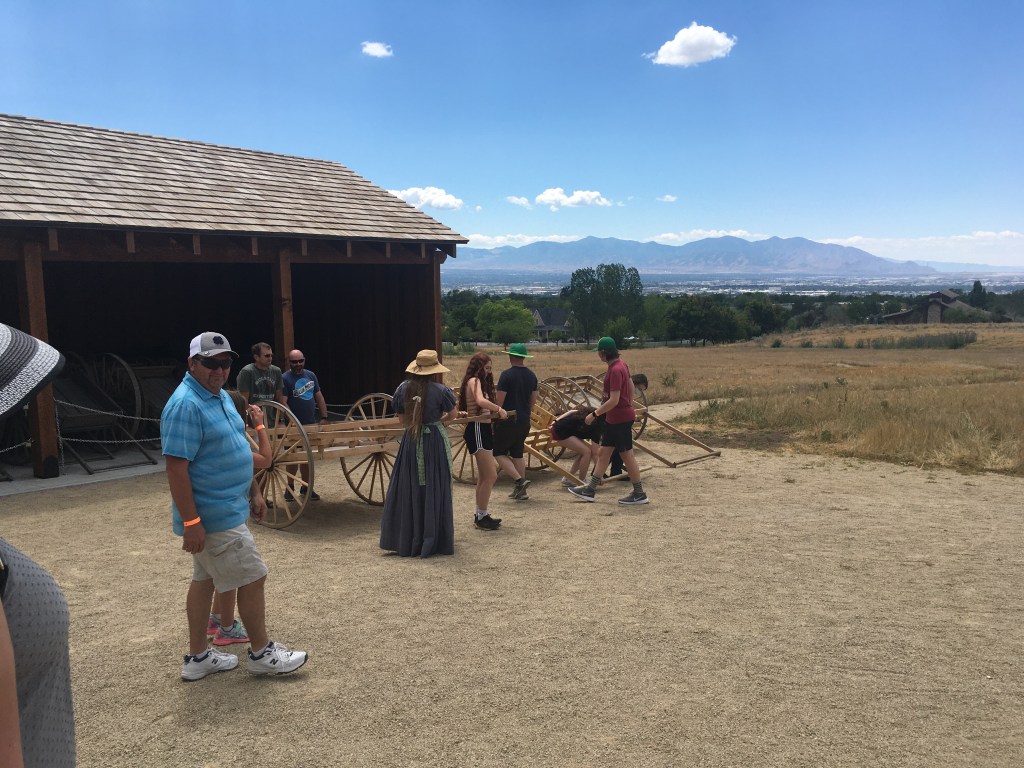
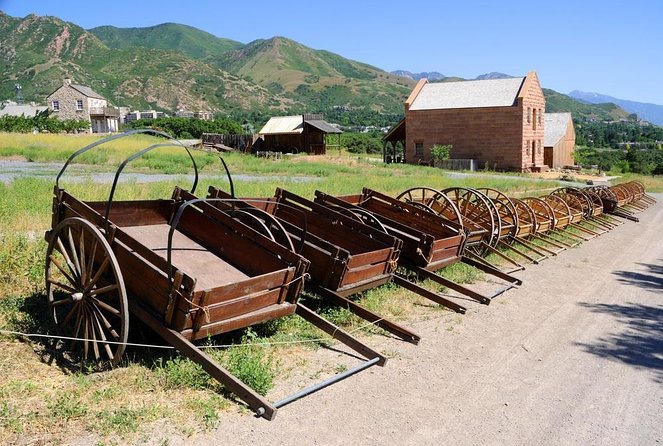
A family group moved through a covered-bridge looking structure ahead of me, over to a barn looking structure situated behind the log cabins. An employee in pioneer dress including a straw hat addressed them, asking if they wanted to take the carts for a spin and hear more about them. They said sure and the woman introduced the carts and their context, which I talked about a little earlier. She also included that each cart could hold about 300-500 pounds of stuff-clothes, food, water, shelter, everything, meaning that everyone who could had to walk or be carried by someone else. With that, she told us about the recreated carts available for test drives- they each weighted 50 pounds and were empty. Two people would pull the cart and two people would push from the back as they navigated a whole dirt course of hills, straightways, curves, and “whoop-de-doos” as I call them- small hills in quick succession. Since I was by myself (and very COVID conscious) I just stood and watched the others hauling their carts around the course. It was at most not much longer than a quarter mile of a course.
It reminded me of a phenomenon of Mormon Handcart Trek reenactments , where participants get decked out in pioneer dress, load up carts, and hike on certain segments of the Mormon Trail, usually for a few days before returning home. There is a whole industry around this now, where you can get your coordinating dresses and bonnets- some say you should have three outfits for the trek (which many actual pioneer folks only had 1-2 sets of clothes, one that was worn and repaired daily and another for special events like church). I’d love to explore this more at some point- from a religious studies point of view it is just brimming with potential- the development of pilgrimage, the mythologization of the Handcart Pioneers and their journey, it goes on and on.
(side note- Desert Book, the official publishing company of the LDS Church made a movie about teenagers on a 3 day trek called Trek-The Movie. For your viewing pleasure (or pain, depending on who you are and what you’re into), here’s the trailer, and here’s a review on the movie, which can only be viewed by purchasing a DVD from Deseret Book)
It was starting to get late- I had been at the park for a few hours and was feeling the impacts of the dryness and warm sun. I wanted to hit the gift shop on the way out for my customary patch and maybe some postcards. What I found was possibly more exciting: a pioneer bonnet. Was it handmade? According to the tag, yes.
Aww yeah
I mean, it’s like going to Disneyland and not getting mouse ears. It’s rare that you escape without them. After seeing the handcart trek section, I was really feeling that “pioneer spirit”.
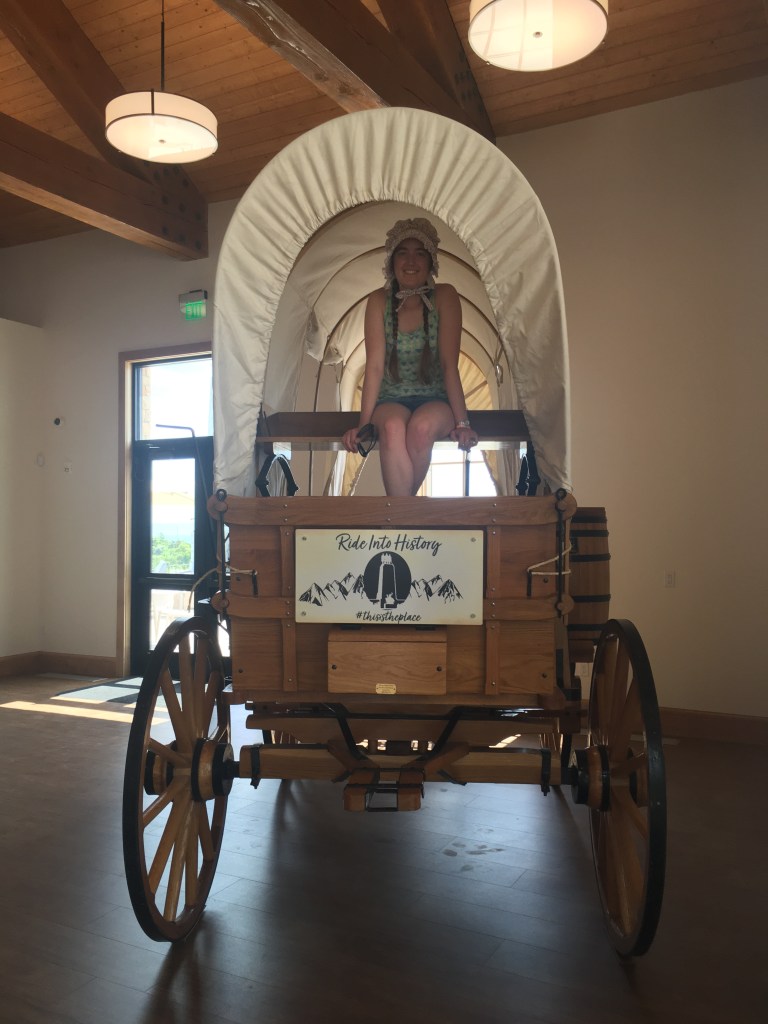
Rockin’ the Bonnet in the Visitor Center covered wagon.
I headed back up the mountain to the ski resort and hotel where my partner was at for the tournament. Somehow, I didn’t get sunburned even though I only put on sunscreen once for the whole day. We were headed back to California via Reno the next day. Even though it was a short trip, I had such a good time exploring and putting my Religious Studies brain to work. I will most definitely be back out there again- hopefully soon, and hopefully by train.
I’m a sucker for puns and plays on words, so I laughed initially, but then realized that was a pretty awful thing to call a deadly disease that was killing people around the world at a growing pace. Then the reports of xenophobia and violence against Asian people poured in.
Recently I was reading a blog to learn more about a local politician and saw his common use of the term “Wuhan Flu” instead of COVID-19. Wuhan flu, China Virus, and Kung Flu are all problematic terms as they inadvertently blame China for the creation of the virus. It’s similar to the “Spanish Flu” which actually originated in the United States but was brought to Spain during WWI, spread rapidly there, and was widely reported on while places like the United States covered up the spread of the disease to not appear weak during the war. Like Asian people today, Spaniards and other people in Europe that were considered undesirable by American immigration officials were blamed for causing and spreading the disease, which led to immigration restrictions. For Chinese immigrants in the 1880s, claims of the immigrants being carriers of contagious diseases was a major point in the 1882 Chinese Exclusion Act. With historical backing like this, it’s not a surprise that the World Health Organization changed their methods of naming diseases to keep people from blaming others for living where a disease originated.
“Viruses know no borders and they don’t care about your ethnicity, the color of your skin or how much money you have in the bank. So it’s really important we be careful in the language we use lest it lead to the profiling of individuals associated with the virus,”
Dr. Mike Ryan, WHO Emergency Program Executive Director
It might seem trivial, but the names we attribute to things do really have impacts on people- I’ll talk more about that in a later post.
Click this link for helpful ways to replace problematic and hurtful descriptions of COVID with more informative ones.
The United States Government has a legacy of taking land from the original Native people, including land that became National Parks. It’s about time it is managed by Native people instead of the US Government.
Notable quotes (and my commentary/thoughts)
But in truth, the North American continent has not been a wilderness for at least 15,000 years: Many of the landscapes that became national parks had been shaped by Native peoples for millennia. Forests on the Eastern Seaboard looked plentiful to white settlers because American Indians had strategically burned them to increase the amount of forage for moose and deer and woodland caribou. Yosemite Valley’s sublime landscape was likewise tended by Native peoples; the acorns that fed the Miwok came from black oaks long cultivated by the tribe. The idea of a virgin American wilderness—an Eden untouched by humans and devoid of sin—is an illusion.
The relationship between nature, civilization, happiness, fear, cleanliness, dirtiness, good, and bad, is a complex one very much colored by a Protestant view of the world, shaped by dichotomies. I often think about how these subconscious dichotomies that so many of us live with shape our lives and our actions, not to mention our experiences in the world.
Diana Almendariz of the Maidu/Patwin tribes sets fire to a redbud pile, a plant used in Native American basketry, during the Tending and Gathering Garden Indigenous Fire Workshop in Woodland. (Alysha Beck/UC Davis) (photo and caption from UC Davis)
Additionally, how awful is it that there was this perspective that things are clean before men touch them. I sense some weird purity culture vibes here as that translates over into other realms like romantic or more intimate relationships. Also, what does that say about the one doing the touching? And how does that affect the toucher’s view of themselves and their world?
More than any other place I visited, Yellowstone seemed to contain the multitudes of America. There, I saw elk and bison. I saw enough recreational vehicles to house a good portion of this country’s homeless. I saw lake water, river water, black water, swamp water, and frothy waterfall water. I saw Tony Hawk being stopped by two park rangers after longboarding down the switchbacks above Mammoth Hot Springs while an actual hawk circled above him. I saw Instagram models in tiny bikinis posing in front of indifferent bison. I saw biker gangs (who seem to really enjoy parks) and gangs of toddlers (who don’t seem to enjoy anything). I saw tourists, masked and unmasked. I saw placards and displays. I discovered that you can learn a lot about nature at Yellowstone, and perhaps even more about American culture. But the park’s official captions give you at best a limited sense of its human history.
I found this to be a particularly entertaining snippet, but also an enlightening one. I can say that on my multiple family trips to Yellowstone, I too can say that I did not see much on the pre-contact history of Yellowstone. And I’m not one of those people who cruises through, sees Old Faithful, and leaves. My sister and I did all the Junior Ranger stuff, attended guided hikes, the whole thing. It was a few years back, of course, maybe around 2010 or 2012 so take that with a grain of salt. Things might be different now, but judging by how the author wrote this, it sounds like it hasn’t changed much. Unless your park has a physical representation of some sort of cultural history, (usually an old building or something) pre or post contact cultural rarely gets talked about. That may be a slight shortcoming of interpretation- it’s hard to interpret things that aren’t there.
p.s: I once saw a lady get within 5 feet of a buffalo at Yellowstone to get a picture. Fricken people.
Around the time they crossed the river, an elderly woman peeled away from the main column and stayed at an area known as Mud Volcano. She sat on a bison robe near a geyser and sang. When a U.S. scout approached her, she closed her eyes. “She seemed rather disappointed,” John W. Redington, the scout, wrote, “when instead of shooting her I refilled her water bottle. She made signs that she had been forsaken by her people, and wanted to die.” Ten minutes later, a Bannock scout for the Army obliged by striking her down and scalping her. One hundred and forty-three years later, my sons and daughter and I would stand on the same spot, wondering why there are so few places in the park where you can learn about its bloody past. Viewed from the perspective of history, Yellowstone is a crime scene.
My first experience volunteering in a Museum was back in 2015 or so when I went to volunteer at Mission San Luis Rey, in San Diego, CA. It’s no secret that the Mission system, like later boarding school systems, were intended to capitalize on Native people’s labor and end cultural practices. If you go to many of those places today, you don’t really see any of that. San Luis Rey, for instance, had just renovated their museum and scarcely mention the Native people outside of the a scene where the Native people (Payómkawichum, or Luise~no Indians- the tilde should be over the n) ran into the ocean after one of the lead Franciscan Friars was sailing away because, according to a docent, he was good to them and they were devastated to see him go. They scarcely mention how the other leaders of the Mission treated the Payómkawichum, only that they were given agricultural work to do and the Payómkawichum occasionally ran away. One thing to note is that that particular museum is operated by the Franciscans themselves, and they may not be up to dealing with that kind of history-which is a disservice to everyone else.
Medora today is a fantasy of a time that never was. There is a statue of Roosevelt and a Rough Riders Hotel and, during the summer months, the Medora Musical. The show’s website really says it best when it promises “the rootin’-tootinest, boot-scootinest show in all the Midwest. There’s no other show quite like it. It’s an ode to patriotism, Theodore Roosevelt, and the Great American West!”
Alright, I’m a victim of checking this kind of stuff out- but mostly because I’m fascinated by the mythic understanding these experiences promote. Did I tell you about “This is the Place Heritage Park” in Salt Lake City Utah? No? Well, I will fix that in a later post. For now, “This is the Place” is a place that interprets the early settlement period of Utah, located at the supposed site where Brigham Young is said to have declared that the Salt Lake Basin below was the new Mormon homeland. It’s… interesting. From an old time community hall selling “Brigham’s Donuts” to opportunities to try out hauling a Handcart (which was an arduous task back in the day where hundreds of people died on the move out West with the carts due to poor planning and poverty) and having a good old time. I call it Mormon Disneyland, and there are many good reasons for that.
There they are- the pushcarts. Fancy a weekend ridearound? Image from Viator
It gets really weird though, when history is used as a base for entertainment, as the entertainment value invariably influences how a person understands history. It gets especially weird when the entertainment begins to seriously bend the truth to the point of becoming propaganda disguised as historical fiction/fact.
In 1905, he and other Native leaders were asked to be part of Roosevelt’s inaugural parade. It was a who’s who of tribal leadership, including Quanah Parker (Comanche), Buckskin Charlie (Ute), Hollow Horn Bear (Brulé Lakota), American Horse (Oglala Lakota), and Little Plume (Piegan Blackfeet). They rode horses down Pennsylvania Avenue in regalia not entirely in step with their individual tribal traditions. America liked and still likes its Indians to function much like its nature: frozen in time; outside history; the antithesis, or at best the outer limit, of humanity and civilization.
I was watching “The Trial of the Chicago Seven” with my sister a few months back and there was a quote in there where one of the main characters was outside a museum and said something along the lines of, “what’s it with Native people always being put in Natural History museums with the dinosaurs?”. It took me a second, but I realized that yup, that is a thing. Why does that matter? Well, do dinosaurs exist anymore? No. So, by relation and extension, do Native people exist anymore? After all, they share a museum. For a significant part of the United States population, their answer would probably be no. That’s an issue. Additionally, it wouldn’t be a far stretch for people to think that by extension, Native people were animals too, and in the Western world, animals are seen as lower on the ladder than humans. There are so many issues with this. Native people don’t exist in the past tense.
There was this one time at the Museum that the Native American Exhibits Curator (who is a local Native person) was up in this loft storage space above the Native American exhibit hall working on something and she could hear people in the exhibit hall talking next to the displays. One of them said “wow, it’s too bad all the Indians are gone”. I don’t think at the time she actually said anything, but when she told me about it after, she was all “yeah, no, I’m literally right over here, still existing and all.” In my mind, I imagine her response was something like this:
The American West began with war but concluded with parks.
Dang, now that is a quote. Bury that war with nice walkways and signs about trees and the wilderness. Don’t forget the John Muir quotes.
The casino industry is the modern expression of a civil right to gamble that we had before white people came along, a right we have retained and that was affirmed by the Supreme Court.
I had not heard of this and I admit I need to do more research to better understand this.
“That group became known as the Xoshga, and they were led by Crow Flies High and Bobtail Bull,” Young Wolf told me. “When they separated, they were taking a stand against assimilation and Christianity. They stayed away for over 20 years.” They revived ceremonies and songs and dances. They preserved knowledge of local plants. While they were gone, Young Wolf said, the community at Like-a-Fishhook Village suffered from being split apart into small plots of land. But the Xoshga “kept our traditions safe while they were away. And it’s because of them we have many of our traditions today.”
In the nation’s mythic past, the wilderness may have been a dangerous environment, something to be tamed, plowed under, cut down. But that way of relating to the land is no longer in vogue. For many Americans, our wild spaces are a solace, a refuge—cathedrals indeed. America has succeeded in becoming more Indian over the past 245 years rather than the other way around.
I mean, this does still persist in many ways, the idea of environment to be tamed. When you’re outside of a set aside park area, this happens all over the place. Without the label of park, unused land is still considered wasted until it’s developed or useful for some sort of money generating scheme. Because Capitalism.
Native people need permanent, unencumbered access to our homelands—in order to strengthen us and our communities, and to undo some of the damage of the preceding centuries. Being Native is not so much a disposition or having a certain amount of blood running through one’s veins as it is a practice around which families and tribes are built.
One Humboldt County example of local Native folks promoting access to homelands managed by the Forest Service, BLM, National and State Parks is the Following the Smoke Symposium, which brings basketweavers and land management agencies together to learn about the importance of cultural burning for basket materials, weaving, and working with Native folks to allow access to federal lands.
Also, All My Relations has at least three episodes relating to this, namely Native DNA and blood quantum (and this one also on blood quantum), and they are outstanding glimpses at the depth of discussion there is around blood quantum and what makes a person Native or not.
National parks are withering as a result of overcrowding, habitat loss, and what Ruch calls a “science deficit.” Even as attendance has increased, park staff has been shrinking, as has the influence of scientists within the Park Service. Ruch’s assessment doesn’t make the Park Service sound like the protective arm of a powerful government safeguarding its “best idea.”
As a person who worked at two State Parks in CA, I can verify this. These resources are being protected in a pretty darn mediocre way, with there being less staff in general in the parks, which is largely a money allotment issue. This means less enforcement of rules (and education of the public on why those rules exist), and most resource loss from people tromping around off trail or hacking burls off of redwood trees. Other larger problems outside of the park that impact the Park’s operations include the lack of attention paid to nearby impoverished local communities, lack of opportunity and the growing opioid epidemic, Parks really are not equipped to handle all the issues coming their way.
It wasn’t the frontier that made us as much as the land itself, land that has always been Native land but that has also come to be American. The national parks are the closest thing America has to sacred lands, and like the frontier of old, they can help forge our democracy anew. More than just America’s “best idea,” the parks are the best of America, the jewels of its landscape.
I get some American Civil Religion vibes here with the “National Parks being the closest thing that America has to sacred lands” quote.
Concluding Thoughts
Back in 2020 was probably when I first heard the term “Land Back” in a serious context. After having a gut reaction of what? That’s crazy, I took a moment to think. There has to be more to this than my gut reaction, which was “how would that even work? Like when I die I just will my house to the local tribe and they figure it out? What about people who purchased their land, would they get paid out for it?”
Thinking back now, a lot of that is pretty problematic- especially considering that the Native people were hardly if ever paid for their land and if they were it was typically a pittance price. Part of this illuminates something that I think most white people won’t ever ask, but is insinuated in the question: If these brown people get their rights, are they going to treat me like how white people have treated them for the last 500 years? Yeah, white people know that brown people got the very short end of the stick and white people will do all they can to stay on top- but you won’t hear them admit that. (want a good book on how and why this happened- and why it continues? White Trash by Nancy Isenberg is the book for you).
Land Back, I’ve come to learn, is about so much more than land, but is also all about the land. If you plant most things in sand, or salted earth, they’ll die. Like that, if you put people on land that they don’t know, in places disconnected from the necessities of life like social connection and culture and crowded with the fixings of poverty, they’ll die too. It’s like if I dropped you in the Alaskan wilderness with no training and minimal random supplies.
Land Back is about giving agency to Native people to make their own decisions about their ancestral lands- access to the land, ability to care for it, being able to make the decisions on when it can be accessed, how, and by who, and how it can be used. It doesn’t necessarily mean ownership, although in our modern day world, that agency is most commonly exercised through ownership of land via physical titles to the land.
Land Back is exercised in other important ways too, removing derogatory names and the names of colonizers and murderers and replacing them with Native names, improving access to traditional and healthy foods through the promotion of food sovereignty, better health care that is balanced with traditional cultural care of the self and spirit. A lot of Land Back is about agency and giving Native people the civil right of making decisions for themselves and their people.
Returning the National Parks to Native people to care for them sounds scary- what if they’re mismanaged? What if they get closed off and no one can go in them? What about the loyal taxpayer who wants to go see some elk or whatever, don’t they have a right?
That is all assuming that there is equal access to the Parks now, which is not true.
In all, who’s to say that Native people can’t do a better job at running parks than white people? I say we give them the chance.
I’ve been on a podcast kick lately- they’re perfect to put on when I take Parker for his morning and evening walks, or when I’m sewing or embroidering or, lately, while doing volunteer shifts at the Redwood Art Association Gallery.
So, here’s what I’ve been listening to:
Photo from Crooked Media’s Website
Native sovereignty is one of those things that I remember being talked about in school a few times, memorized for a test, then ditched for… a long time. I guess in theory I got that Native people have control over their lands, but the reality of how that actually works is significantly more complicated and by no means guaranteed.
From Crooked Media, This Land is a podcast researched and hosted by Rebecca Nagle, a citizen of Cherokee Nation. It’s now on it’s second season, which is exploring the recent court attacks on ICWA (sometimes pronounced Ick-Wah), which is the Indian Child Welfare Act. It has been fascinating to listen to, and so far the most interesting episode for me has been “Supply and Demand”. It definitely has some really difficult moments and discussions, but it is an excellently made podcast. From Season one to Season Two, Nagle explores how Native sovereignty is continually under attack on multiple fronts, and in the most inconspicuous of ways. After all, on the surface the foster system and control over sovereign lands seem to have nothing in common, but dig a little deeper and it is very, very connected. Speaking of connections…
I first heard of All My Relations from one of my past coworkers at the museum, but I guess at the time I wasn’t much of a podcast listener. I picked it back up and DANG is it good. The titles seem pretty straightforward but the topics discussed usually expand far outward, so I personally recommend listening to all the episodes as there are some really great points made all along the way. Hosts Matika and Adrienne are really personable, bounce ideas around in a thoughtful and entertaining way, and really dig deep into issues facing Indian Country. They also bring in really great people to interview on topics like DNA, fashion, and more. As a non-Native person, I’ve learned a heck of a lot and I 100% recommend it. Episodes range in time from about a half hour to an hour and a half.
Nice White Parents was one of the first podcasts I found when I started getting back into podcasts while walking Parker. It explores the desegregation of schools historically and in the present, the role of charter schools in that journey, and how well-meaning but misunderstanding white parents can really throw a wrench in positive school reforms.
So, I do listen to a number of pretty serious podcasts, but this one is a bit more… fun. Wind of Change seeks to answer one question: Was the Scorpion’s song “Wind of Change” actually written by the CIA to take down the Soviet Union? For some reason the Cold War was largely glazed over in my public school education- pretty much most things past probably WWI now that I think of it- so this was a fun ride in learning more about the Cold War and the generalized intrigue that surrounded it. Definitely bingeable!
If it’s got Mormons, 9 times out of 10 I will be interested in it. I listened to Bundyville season 1 and 2 a while back now, probably something like two or three years ago. I don’t know that there will ever be another season of this show, but that’s ok. It explores some pretty fascinating connections between the Church of Latter Day Saints, ol’ westward expansionism, white supremacy, domestic terrorism, and much more.
That’s it for now, but that’s at least a few solid days worth of podcasts to listen to, so hopefully you saw one that piqued your interest. Share your favorite podcasts or what you’re listening to these days in the comments.
We have a Victorian Tea Party coming up next weekend and I’m in charge of the program for the day’s festivities since two of my favorite historical topics are Victorians and Tea (also, I don’t mind public speaking, I bet that has something to do with it)
The Victorian Period was one of immense change- The Great Internet Brain (Google) says that the Victorian period lasted from June 20, 1837 to January 22, 1901, which was when Queen Victoria began her reign until she died. I’d say the period itself ended a little after 1901 because travel and communication was still slow ish at the time, and when it comes to historical periods, very rarely does one completely end and another one begin. There’s a lot more blurring that happens. Some historians say the Victorian Period wrapped up closer to 1915 or even as late as 1920. Anyway, those are the dates for the test at the end of this post.
When it comes to periods of massive change, people like to find some sort of safe harbor where things are, well, less crazy. The craziness of the Victorian Period extended through basically every social class and caused some serious upheval, but what is mostly remembered today are the weird rules that came about during the period, like how you can’t wear white after labor day. This is Murica, I do what I want you weird history people. Good news for us, the upheaval and the weird rules are connected in a pretty reasonable (ish) way.
So here’s the thing- industrialization happened extensively in the Victorian Period. Let’s start from the bottom- and keep in mind that this is a bit England-centric, but you do see similar things happening particularly in the American Northeast, which became the industrial capitol of the US.
If you were some dude out in a rural town in England, it was pretty likely that for a long time you raised your animals, and your crops, and you sold your extra stuff to some neighbors. Maybe you had some extra wool that you sold to the cute neighborlady who could turn it into yarn that someone else could make into a real nice sweater.
Then, one day, a shop opens up in town, let’s call it “OldeMart” that has that sweater for a quarter of the cost. The shop owner picked them up from a steam powered mill where a hundred people could pump out hundreds of those awesome sweaters a day. A few weeks later, the cute neighbor lady announces that she’s moving to go work in the mill. Darn. Guess she won’t be having 15 of your babies. The OldeMart guy makes a killing selling his inexpensive goods and opens OldeMarts across England. He even does mail orders. 30 day shipping, for anywhere in England, what a deal!
Let’s say OldeMart guy decides to invest some of his cash into a railroad that’s being built to connect England, perhaps the railroad is called “Thames”. He makes a heck of a lot of money off the success of the railroad, which transports the cheap goods from factories to OldeMarts across the country. OldeMart Guy is now well into the wealthy classes- he would be considered upper middle class. He was part of the group who made their money from industry, a relatively new class of person compared to the upper crust folks who inherited their money from their great uncle who married his cousin to strengthen family ties and everyone has a strikingly similar nose…
Now we have a ton of people losing their cottage jobs in the country and moving to cities to work in these factories. There’s no OSHA at this point, and the work was, well, brutal. Tons of people died in workplace related incidences. Don’t even get me started on workhouses. That’s for another time when I rant a bit about how Capitalism Strikes Again.
So OldeMart Guy has the fancy clothes, and wants to hang out with the other ritzy folk, who already have their own ways of operating (see Downton Abbey for some great examples of all this). But it’s not that easy to just be “in”. After all, didn’t that guy used to be the Chauffer? People have their place, you know, and for centuries that was just generally how it was. Social Mobility? Pshh. It was going to take more than some fancy dinner clothes to make other people accept you if you were newly part of the “in” crowd, if they ever accepted you at all.
With new wealthy folks on the scene, the current ones wanted to be sure that their place was secure and you knew who was on your side and from a similar background as you. Hence, rules. If you saw someone wear white after Labor Day, you could easily identify them as a person who didn’t know what was in, out, up or down. Bye Felicia. Keep up with the Joneses, OldeMart Guy.
These social rules exploded throughout the Victorian Period, volumes and volumes of books offered advice that changed by the year for folks to figure out how to behave. People who were well off enough to study ettiquette all day could quickly separate themselves out from those working folks who didn’t have time for that. The writings were heavily influenced by religion, and enforced really strict rules on how not only men and women should behave on their own, but when it was ok for them to interact, how they should interact, who else should be present, all of that. These rules began institutionalizing the ideas of a men’s sphere and a woman’s sphere of existence.
When you grew up walking from place to place with no indoor plumbing working on a farm owned by your family for generations and the world is literally now at the point where you can now travel at 40 miles an hour across certain parts of the country in a train (unless you were a woman, in which case your innards might fall out if you went that fast so you have to stay home) and steam can allow you to make more sweaters in one year than you could make in your life, you start grasping at straws to find some kind of continuity and reliability in your life. Telling people how to live their lives so they can be accepted and maybe grow their business connections is a great way to do that.
In the context of big changes, it makes a bit more sense that people grasped to weird rules to find out who was part of the “in crowd”. These rules, while they seem a bit ridiculous to us today, provided a foundation that a lot of our present day world is built on and that many people are trying to buck- a “woman’s place being in the home” and gendered ideals of how people are supposed to exist. They’ve also created a great foundation for TV drama so… there’s that.



















 Katie Buesch