The Chinatown related project I’ve been working on most recently has been “Geography of Chinatown.” It’s for a Public History seminar class that I’m enrolled in, where the main assignment is to use the website HistoryPin to highlight a historically underrepresented community by literally putting them on the map with images and other multimedia and narrative to tie the story of a community together. I immediately thought about recent conversations around the future of the Eureka Chinatown project, which consisted of thoughts about creating an AAPI Chamber of commerce or some other support network for AAPI businesses in Eureka and Humboldt County. Earlier this year, I had been working on a research project to better understand the businesses that were impacted by the Wing Hing v. City of Eureka court case (which later became an article in the Humboldt Historian), so businesses were on my mind.

There was so little information available or compiled on Chinese businesses specifically in Eureka, including their owners and operators, what they dealt in, and even where they were located. In an ongoing quest to humanize Eureka’s historic Chinese population, I figured this would be a good place to start, since businesses are frequently referred to in things like government documents, which tend to contain information on populations who might not have their own extant records. I was beginning this journey with the Wing Hing v. City of Eureka court documents, one advertisement for “Kang Hop Co” which thankfully had a vague address, and the 1886 Sanborn maps for Eureka- unfortunately the year after the expulsion happened.
I went over to FamilySearch, good ol’ Mormons and their extensive and free to access database, and began sifting around their documentation for 1870 and 1880 census records in Eureka, writing down names, occupations, and ages. Unfortunately, the records didn’t list home addresses or work addresses. Many of the Chinese people listed though worked as servants or cooks, and were listed in the same households as non-Chinese individuals, indicating they were live-in cooks or servants, so my next step will be to try and track down the non-Chinese inhabitants, located their homes or workplaces, and map those with the information on the Chinese worker who lived there. I was surprised to see that some of the congregate living areas were actually outside of individual homes- there were a number of Chinese workers associated with a nearby shingle mill for instance, and some associated with a “Hospital and Almshouse” which I need to locate still.

A major breakthrough came from Eureka Chinatown Project member and friend Vicki Ozaki- If you’ve seen the annotated Sanborn Maps in any of the presentations I’ve done, those have come from Vicki. I love that map as it has made a huge difference in the interpretation we can do about the Chinatown story and I will always be thankful to Vicki for her work in assembling it. I had posed a question to the Eureka Chinatown Project email group and Vicki sent over a Sanborn Map that she had found nestled in a collection related to a lawsuit about the Eureka waterfront and who owned certain areas. That collection contained the maps that we had all been hoping to find but didn’t think existed: the 1884 Sanborn Map for Eureka. Not only was it the map from before the expulsion, but a number of Chinese businesses were specifically labeled as Chinese owned. With that map, we went from knowing the specific locations of three businesses to knowing the locations of nine Chinese owned businesses.
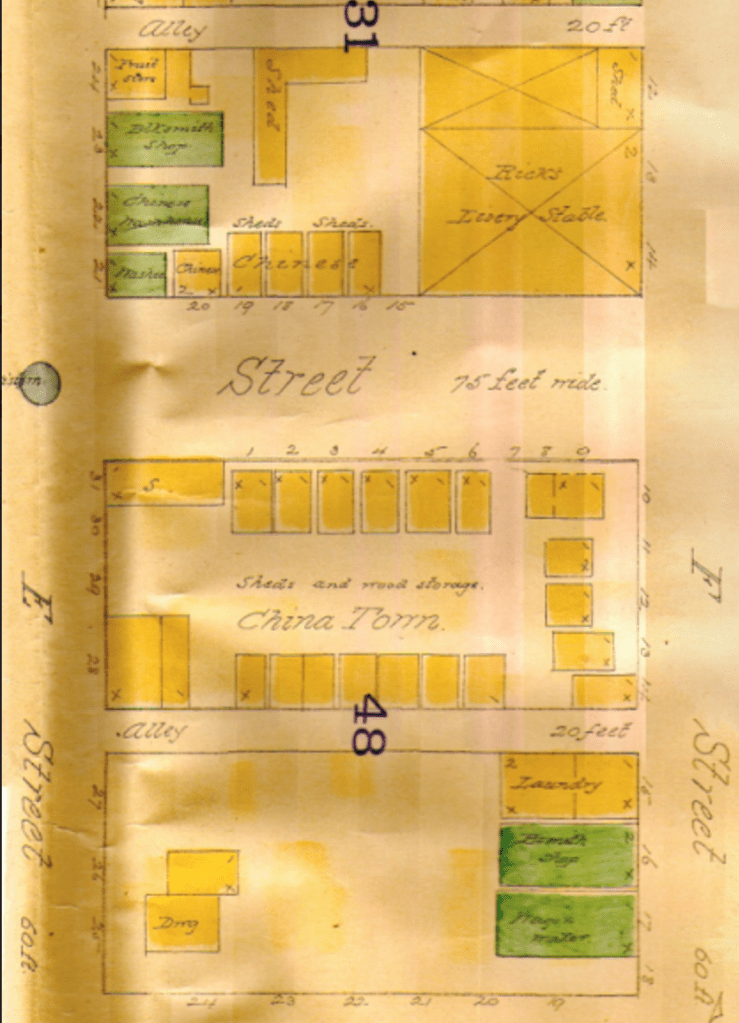

Work continues on this project, but it has been a really interesting one so far. I’ve reached out to railroad historians to try and determine where Chinese workers who were listed as working on the railroad might have been working during the 1880 census and calling around to track down testimonies of Chinese businesspeople who were part of the Wing Hing court case. The testimonies were passingly mentioned in the work of a past local historian, Lynwood Carranco, and unfortunately they have proven to be incredibly hard to locate despite supposedly being located at the County courthouse, a few blocks from where Chinatown once stood.
There are a lot of things that I probably won’t ever be able to find out for certain- census records are noticeably incorrect or incomplete likely due to language and cultural barriers so it can be impossible to track people before they came to Humboldt, or after they were removed, and missing business records means we might not know for sure who owned or worked at a given business. Piecing together what we do have is more than what we did have, and is progress towards a better understanding of this community on the eve of a historical, tragic event.
Stay tuned for more updates- you can subscribe to my blog on the homepage of this website to get automatic updates on my progress!
 Katie Buesch