The Article:
The Atlantic: Return the National Parks to the Tribes
TLDR:
The United States Government has a legacy of taking land from the original Native people, including land that became National Parks. It’s about time it is managed by Native people instead of the US Government.
Notable quotes (and my commentary/thoughts)
But in truth, the North American continent has not been a wilderness for at least 15,000 years: Many of the landscapes that became national parks had been shaped by Native peoples for millennia. Forests on the Eastern Seaboard looked plentiful to white settlers because American Indians had strategically burned them to increase the amount of forage for moose and deer and woodland caribou. Yosemite Valley’s sublime landscape was likewise tended by Native peoples; the acorns that fed the Miwok came from black oaks long cultivated by the tribe. The idea of a virgin American wilderness—an Eden untouched by humans and devoid of sin—is an illusion.
The relationship between nature, civilization, happiness, fear, cleanliness, dirtiness, good, and bad, is a complex one very much colored by a Protestant view of the world, shaped by dichotomies. I often think about how these subconscious dichotomies that so many of us live with shape our lives and our actions, not to mention our experiences in the world.

Additionally, how awful is it that there was this perspective that things are clean before men touch them. I sense some weird purity culture vibes here as that translates over into other realms like romantic or more intimate relationships. Also, what does that say about the one doing the touching? And how does that affect the toucher’s view of themselves and their world?
More than any other place I visited, Yellowstone seemed to contain the multitudes of America. There, I saw elk and bison. I saw enough recreational vehicles to house a good portion of this country’s homeless. I saw lake water, river water, black water, swamp water, and frothy waterfall water. I saw Tony Hawk being stopped by two park rangers after longboarding down the switchbacks above Mammoth Hot Springs while an actual hawk circled above him. I saw Instagram models in tiny bikinis posing in front of indifferent bison. I saw biker gangs (who seem to really enjoy parks) and gangs of toddlers (who don’t seem to enjoy anything). I saw tourists, masked and unmasked. I saw placards and displays. I discovered that you can learn a lot about nature at Yellowstone, and perhaps even more about American culture. But the park’s official captions give you at best a limited sense of its human history.
I found this to be a particularly entertaining snippet, but also an enlightening one. I can say that on my multiple family trips to Yellowstone, I too can say that I did not see much on the pre-contact history of Yellowstone. And I’m not one of those people who cruises through, sees Old Faithful, and leaves. My sister and I did all the Junior Ranger stuff, attended guided hikes, the whole thing. It was a few years back, of course, maybe around 2010 or 2012 so take that with a grain of salt. Things might be different now, but judging by how the author wrote this, it sounds like it hasn’t changed much. Unless your park has a physical representation of some sort of cultural history, (usually an old building or something) pre or post contact cultural rarely gets talked about. That may be a slight shortcoming of interpretation- it’s hard to interpret things that aren’t there.

p.s: I once saw a lady get within 5 feet of a buffalo at Yellowstone to get a picture. Fricken people.
Around the time they crossed the river, an elderly woman peeled away from the main column and stayed at an area known as Mud Volcano. She sat on a bison robe near a geyser and sang. When a U.S. scout approached her, she closed her eyes. “She seemed rather disappointed,” John W. Redington, the scout, wrote, “when instead of shooting her I refilled her water bottle. She made signs that she had been forsaken by her people, and wanted to die.” Ten minutes later, a Bannock scout for the Army obliged by striking her down and scalping her. One hundred and forty-three years later, my sons and daughter and I would stand on the same spot, wondering why there are so few places in the park where you can learn about its bloody past. Viewed from the perspective of history, Yellowstone is a crime scene.
My first experience volunteering in a Museum was back in 2015 or so when I went to volunteer at Mission San Luis Rey, in San Diego, CA. It’s no secret that the Mission system, like later boarding school systems, were intended to capitalize on Native people’s labor and end cultural practices. If you go to many of those places today, you don’t really see any of that. San Luis Rey, for instance, had just renovated their museum and scarcely mention the Native people outside of the a scene where the Native people (Payómkawichum, or Luise~no Indians- the tilde should be over the n) ran into the ocean after one of the lead Franciscan Friars was sailing away because, according to a docent, he was good to them and they were devastated to see him go. They scarcely mention how the other leaders of the Mission treated the Payómkawichum, only that they were given agricultural work to do and the Payómkawichum occasionally ran away. One thing to note is that that particular museum is operated by the Franciscans themselves, and they may not be up to dealing with that kind of history-which is a disservice to everyone else.

Medora today is a fantasy of a time that never was. There is a statue of Roosevelt and a Rough Riders Hotel and, during the summer months, the Medora Musical. The show’s website really says it best when it promises “the rootin’-tootinest, boot-scootinest show in all the Midwest. There’s no other show quite like it. It’s an ode to patriotism, Theodore Roosevelt, and the Great American West!”
Alright, I’m a victim of checking this kind of stuff out- but mostly because I’m fascinated by the mythic understanding these experiences promote. Did I tell you about “This is the Place Heritage Park” in Salt Lake City Utah? No? Well, I will fix that in a later post. For now, “This is the Place” is a place that interprets the early settlement period of Utah, located at the supposed site where Brigham Young is said to have declared that the Salt Lake Basin below was the new Mormon homeland. It’s… interesting. From an old time community hall selling “Brigham’s Donuts” to opportunities to try out hauling a Handcart (which was an arduous task back in the day where hundreds of people died on the move out West with the carts due to poor planning and poverty) and having a good old time. I call it Mormon Disneyland, and there are many good reasons for that.
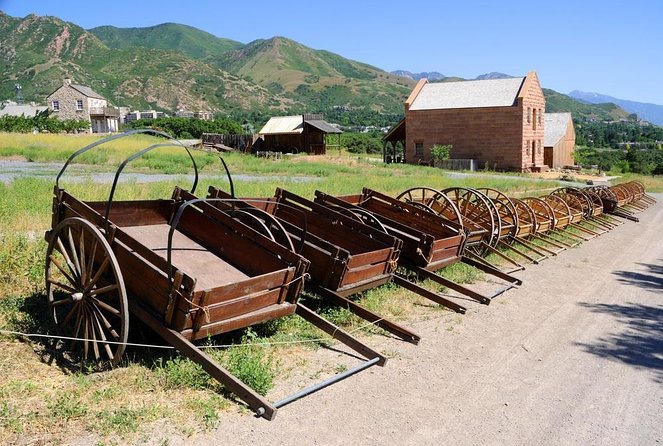
It gets really weird though, when history is used as a base for entertainment, as the entertainment value invariably influences how a person understands history. It gets especially weird when the entertainment begins to seriously bend the truth to the point of becoming propaganda disguised as historical fiction/fact.
In 1905, he and other Native leaders were asked to be part of Roosevelt’s inaugural parade. It was a who’s who of tribal leadership, including Quanah Parker (Comanche), Buckskin Charlie (Ute), Hollow Horn Bear (Brulé Lakota), American Horse (Oglala Lakota), and Little Plume (Piegan Blackfeet). They rode horses down Pennsylvania Avenue in regalia not entirely in step with their individual tribal traditions. America liked and still likes its Indians to function much like its nature: frozen in time; outside history; the antithesis, or at best the outer limit, of humanity and civilization.

I was watching “The Trial of the Chicago Seven” with my sister a few months back and there was a quote in there where one of the main characters was outside a museum and said something along the lines of, “what’s it with Native people always being put in Natural History museums with the dinosaurs?”. It took me a second, but I realized that yup, that is a thing. Why does that matter? Well, do dinosaurs exist anymore? No. So, by relation and extension, do Native people exist anymore? After all, they share a museum. For a significant part of the United States population, their answer would probably be no. That’s an issue. Additionally, it wouldn’t be a far stretch for people to think that by extension, Native people were animals too, and in the Western world, animals are seen as lower on the ladder than humans. There are so many issues with this. Native people don’t exist in the past tense.
There was this one time at the Museum that the Native American Exhibits Curator (who is a local Native person) was up in this loft storage space above the Native American exhibit hall working on something and she could hear people in the exhibit hall talking next to the displays. One of them said “wow, it’s too bad all the Indians are gone”. I don’t think at the time she actually said anything, but when she told me about it after, she was all “yeah, no, I’m literally right over here, still existing and all.” In my mind, I imagine her response was something like this:

The American West began with war but concluded with parks.
Dang, now that is a quote. Bury that war with nice walkways and signs about trees and the wilderness. Don’t forget the John Muir quotes.
The casino industry is the modern expression of a civil right to gamble that we had before white people came along, a right we have retained and that was affirmed by the Supreme Court.
I had not heard of this and I admit I need to do more research to better understand this.
“That group became known as the Xoshga, and they were led by Crow Flies High and Bobtail Bull,” Young Wolf told me. “When they separated, they were taking a stand against assimilation and Christianity. They stayed away for over 20 years.” They revived ceremonies and songs and dances. They preserved knowledge of local plants. While they were gone, Young Wolf said, the community at Like-a-Fishhook Village suffered from being split apart into small plots of land. But the Xoshga “kept our traditions safe while they were away. And it’s because of them we have many of our traditions today.”
Also want to learn more about this.

In the nation’s mythic past, the wilderness may have been a dangerous environment, something to be tamed, plowed under, cut down. But that way of relating to the land is no longer in vogue. For many Americans, our wild spaces are a solace, a refuge—cathedrals indeed. America has succeeded in becoming more Indian over the past 245 years rather than the other way around.
I mean, this does still persist in many ways, the idea of environment to be tamed. When you’re outside of a set aside park area, this happens all over the place. Without the label of park, unused land is still considered wasted until it’s developed or useful for some sort of money generating scheme. Because Capitalism.
Native people need permanent, unencumbered access to our homelands—in order to strengthen us and our communities, and to undo some of the damage of the preceding centuries. Being Native is not so much a disposition or having a certain amount of blood running through one’s veins as it is a practice around which families and tribes are built.
One Humboldt County example of local Native folks promoting access to homelands managed by the Forest Service, BLM, National and State Parks is the Following the Smoke Symposium, which brings basketweavers and land management agencies together to learn about the importance of cultural burning for basket materials, weaving, and working with Native folks to allow access to federal lands.
Also, All My Relations has at least three episodes relating to this, namely Native DNA and blood quantum (and this one also on blood quantum), and they are outstanding glimpses at the depth of discussion there is around blood quantum and what makes a person Native or not.
National parks are withering as a result of overcrowding, habitat loss, and what Ruch calls a “science deficit.” Even as attendance has increased, park staff has been shrinking, as has the influence of scientists within the Park Service. Ruch’s assessment doesn’t make the Park Service sound like the protective arm of a powerful government safeguarding its “best idea.”
As a person who worked at two State Parks in CA, I can verify this. These resources are being protected in a pretty darn mediocre way, with there being less staff in general in the parks, which is largely a money allotment issue. This means less enforcement of rules (and education of the public on why those rules exist), and most resource loss from people tromping around off trail or hacking burls off of redwood trees. Other larger problems outside of the park that impact the Park’s operations include the lack of attention paid to nearby impoverished local communities, lack of opportunity and the growing opioid epidemic, Parks really are not equipped to handle all the issues coming their way.
It wasn’t the frontier that made us as much as the land itself, land that has always been Native land but that has also come to be American. The national parks are the closest thing America has to sacred lands, and like the frontier of old, they can help forge our democracy anew. More than just America’s “best idea,” the parks are the best of America, the jewels of its landscape.
I get some American Civil Religion vibes here with the “National Parks being the closest thing that America has to sacred lands” quote.
Concluding Thoughts
Back in 2020 was probably when I first heard the term “Land Back” in a serious context. After having a gut reaction of what? That’s crazy, I took a moment to think. There has to be more to this than my gut reaction, which was “how would that even work? Like when I die I just will my house to the local tribe and they figure it out? What about people who purchased their land, would they get paid out for it?”
Thinking back now, a lot of that is pretty problematic- especially considering that the Native people were hardly if ever paid for their land and if they were it was typically a pittance price. Part of this illuminates something that I think most white people won’t ever ask, but is insinuated in the question: If these brown people get their rights, are they going to treat me like how white people have treated them for the last 500 years? Yeah, white people know that brown people got the very short end of the stick and white people will do all they can to stay on top- but you won’t hear them admit that. (want a good book on how and why this happened- and why it continues? White Trash by Nancy Isenberg is the book for you).
Land Back, I’ve come to learn, is about so much more than land, but is also all about the land. If you plant most things in sand, or salted earth, they’ll die. Like that, if you put people on land that they don’t know, in places disconnected from the necessities of life like social connection and culture and crowded with the fixings of poverty, they’ll die too. It’s like if I dropped you in the Alaskan wilderness with no training and minimal random supplies.
Land Back is about giving agency to Native people to make their own decisions about their ancestral lands- access to the land, ability to care for it, being able to make the decisions on when it can be accessed, how, and by who, and how it can be used. It doesn’t necessarily mean ownership, although in our modern day world, that agency is most commonly exercised through ownership of land via physical titles to the land.
Land Back is exercised in other important ways too, removing derogatory names and the names of colonizers and murderers and replacing them with Native names, improving access to traditional and healthy foods through the promotion of food sovereignty, better health care that is balanced with traditional cultural care of the self and spirit. A lot of Land Back is about agency and giving Native people the civil right of making decisions for themselves and their people.
Returning the National Parks to Native people to care for them sounds scary- what if they’re mismanaged? What if they get closed off and no one can go in them? What about the loyal taxpayer who wants to go see some elk or whatever, don’t they have a right?
That is all assuming that there is equal access to the Parks now, which is not true.
In all, who’s to say that Native people can’t do a better job at running parks than white people? I say we give them the chance.
 Katie Buesch